
FOUNDATIONAL DIAGNOSTIC FRAMEWORK - POLICY RESEARCH
Digitized Compliance: How PowerDMS Can Amplify Legacy Police Policy Failure
By Theodore L. Bremer Jr.
Abstract
PowerDMS is not the cause of legacy police policy failure. It is a digital implementation platform that can either expose, discipline, or amplify the policy culture of the agency using it. This paper analyzes how PowerDMS, PowerStandards, and accreditation based compliance workflows may intensify legacy police policy failure when agencies use digital systems primarily for policy distribution, electronic acknowledgment, standards mapping, dashboard completion, and archival proof rather than meaningful training, comprehension verification, supervisory reinforcement, corrective action, and policy revision. The central question is whether PowerDMS documents policy implementation or merely documents digital completion.
The paper argues that PowerDMS should be understood as legally neutral but operationally consequential infrastructure. Used well, the platform can support policy currency, version control, training alignment, accreditation management, supervisory follow up, testing, corrective action, and revision after warning signs. Used passively, however, it can transform weak implementation into a professional, searchable, timestamped, and discoverable record. In that setting, a department may appear more organized while still failing to prove that Officers were trained, understood the policy, were supervised under it, or were corrected when policy failures appeared.
This paper also examines the structural role of PowerStandards within accreditation. When accrediting bodies embed standards manuals, proof mapping, assessment workflows, and accreditation management into PowerStandards, PowerDMS may become more than one optional vendor selected by an agency. It may become part of the practical pathway to accreditation. This creates a platform dependency concern, especially as accreditation becomes increasingly important for legitimacy, grants, insurance, liability posture, municipal oversight, and professional standing. The concern is not that PowerDMS holds an unlawful monopoly or that accreditation is inherently defective. The concern is that vendor mediated accreditation workflows may push weak agencies into digital compliance systems before those agencies have the internal training, supervision, policy writing, and corrective capacity needed to use those systems well.
The paper’s central thesis is that digitized compliance does not automatically produce operational competence. Digital platforms amplify the implementation culture already present inside the agency. In strong agencies, PowerDMS and PowerStandards can help document disciplined governance. In weak agencies, the same tools may scale passive compliance by converting policy work into assignment completion, standards mapping, electronic signatures, and dashboard readiness. The result is a modernized form of legacy policy failure: not a dusty manual ignored on a shelf, but a polished digital record showing that the agency tracked compliance activity without proving policy function.
Outline
I. Introduction
II. Why PowerDMS Is the Case Study
III. PowerDMS as an Implementation Amplifier
IV. PowerStandards, Accreditation, and Platform Dependency
V. Passive Compliance and the Electronic Acknowledgment Problem
VI. Client Training, Administrator Succession, and the Passive Use Gap
VII. The Weak Agency Tipping Point
VIII. Empirical Limits and the Absence of a Use Quality Dataset
IX. Litigation Exposure and the Discoverable Digital Record
X. Governance Risk, Procurement Pressure, and Vendor Mediated Compliance
XI. Implementation Safeguards for Digital Policy Systems
XII. Discussion: Digitized Compliance as a Theory of Policy Failure
XIII. Conclusion
I. Introduction
The Digital Compliance Problem
Police policy failure was once easy to imagine as a paper problem. A directive sat in a binder. An outdated manual remained on a shelf. A policy update moved slowly through email, roll call, and command review. That version of the problem still exists, but it is no longer the full problem. In many agencies, policy now moves through digital systems that distribute directives, track acknowledgments, preserve version histories, organize accreditation proofs, and create administrative dashboards. The policy manual has not disappeared. It has become digitized.
Digitization can improve policy governance. A platform can make directives easier to find, update, assign, track, and audit. It can connect policies to training, accreditation, testing, field training, professional standards, and administrative review. Used well, digital policy management can help an agency maintain a more disciplined policy system than a paper manual ever could. The danger is that the same system can also make weak implementation look organized.
This paper examines that danger through PowerDMS and PowerStandards. PowerDMS is not treated here as the cause of legacy police policy failure. The issue is not whether PowerDMS is defective software. The issue is whether a powerful digital compliance platform can amplify the policy culture of the agency using it. If the agency is disciplined, the platform can support implementation. If the agency is passive, the platform may convert passive policy practices into searchable, timestamped, and discoverable records.
Why PowerDMS is the Case Study
PowerDMS is the proper case study because it is not a marginal platform in public safety compliance work. Independent public reporting described PowerDMS as having more than 4,000 customers across public and private sectors by 2020, and law-enforcement trade coverage has described it as used by agencies across the United States for electronic policy delivery and tracking (Westrope, 2020; Police1, 2019). PowerDMS’s own public materials describe a platform tied to policy management, training, accreditation, field training, professional standards, internal affairs related documentation, scheduling, and public safety operations (PowerDMS, n.d.-a, n.d.-b). That breadth matters. PowerDMS is not merely a digital filing cabinet. It is part of a broader policy and compliance ecosystem.
The paper does not focus on PowerDMS because it is uniquely harmful. It focuses on PowerDMS because the platform is sufficiently visible, adopted, and integrated into public safety compliance work to make it analytically useful. A generic discussion of “software” would be too abstract. PowerDMS provides a concrete example of how digital policy management can support meaningful implementation or, if used passively, preserve evidence that implementation never moved beyond assignment, acknowledgment, and dashboard completion.
This distinction is important for fairness and accuracy. The paper does not claim that most PowerDMS clients use the platform passively. No public empirical dataset identified in this review quantifies how often agencies use PowerDMS as a full implementation system versus a digital acknowledgment system. The narrower claim is that passive use is a foreseeable risk when agencies treat digital completion as evidence of policy function.
The PowerStandards Accreditation Layer
PowerStandards adds a second layer to the problem. Accreditation is not only a policy management task. It is a professional legitimacy system. Agencies seek accreditation to demonstrate structure, standards alignment, independent assessment, professional discipline, and readiness for external review. The New Jersey State Association of Chiefs of Police describes accreditation as a process involving standards, self-analysis, independent assessment, and implemented policies and procedures, and also notes that accredited agencies may be eligible for insurance rate discounts (NJSACOP, n.d.). That matters because accreditation can affect how an agency is seen by municipal officials, insurers, outside reviewers, and the public.
When accreditation standards, proof mapping, assessment workflows, and compliance tasks are managed through a vendor platform, the platform becomes part of the practical accreditation environment. PowerDMS describes accreditation management software that maps policies, procedures, and proofs of compliance to standards manuals. CALEA provides the clearest public example of this platform relationship: CALEA states that enrolled agencies receive access to PowerStandards to view CALEA standards electronically and build the electronic assessment. CALEA also describes PowerDMS as a public safety platform used in that accreditation environment (PowerDMS, n.d.-c; CALEA, n.d.).
This creates a platform dependency concern. The concern is not that accreditation is improper or that PowerStandards is unlawful. The concern is that when accrediting bodies embed standards manuals and assessment workflows into PowerStandards, agencies may experience PowerDMS not merely as one optional software vendor, but as part of the pathway to accreditation. That concern is strengthened by state-level examples. In Illinois, for example, the Illinois Association of Chiefs of Police announced that agencies applying for ILEAP accreditation after September 1, 2021, had to sign up for PowerDMS before formally pursuing ILEAP accreditation (Illinois Association of Chiefs of Police, 2021).
The risk is greatest for weaker agencies. A strong agency may use PowerStandards to organize proof, map standards, trigger review, update policy, assign training, test comprehension, and document corrective action. A weak agency may use the same platform to upload proofs, clear tasks, collect signatures, and appear accreditation ready without becoming operationally stronger. In that setting, accreditation pressure and digital compliance infrastructure can converge before internal agency capacity has matured.
The Paper’s Central Claim
The central claim of this paper is that digitized compliance does not automatically produce operational competence. Digital systems amplify the implementation culture already present inside the agency. A disciplined agency can use PowerDMS and PowerStandards to create a living policy implementation system. A weak agency can use the same tools to create a polished record of administrative completion.
This paper therefore asks a focused question: Did PowerDMS document meaningful policy implementation, or did it merely document digital completion? That question separates policy function from policy appearance. It asks whether the system shows training, comprehension verification, supervisory reinforcement, corrective action, and revision after warning signs, or whether it shows only distribution, acknowledgment, standards mapping, dashboards, and archived proof.
The answer matters because digital records can become legal and operational evidence. A PowerDMS record may help an agency prove that a directive was current, assigned, trained, tested, supervised, and revised. It may also show that an agency assigned a high-liability directive, collected a signature, cleared a dashboard, and did little more. The same platform can therefore document discipline or expose passivity.
Scope and Limitation
This paper does not claim that PowerDMS causes failure to train, failure to supervise, or legacy policy failure. It does not claim that PowerDMS holds an unlawful monopoly. It does not claim that accreditation is defective. It does not claim that state accreditation programs are categorically weak. Those claims would exceed the available evidence.
The paper makes a narrower argument. PowerDMS and PowerStandards are legally neutral but operationally consequential infrastructure. Their significance depends on how agencies use them. When agencies connect digital policy management to training, comprehension, supervision, correction, and revision, the platform can strengthen governance. When agencies reduce digital policy management to assignment, acknowledgment, proof mapping, and dashboard completion, the platform may amplify the very legacy policy failure it appears to solve.
II. Why PowerDMS is the Case Study
Widespread Public Safety Use, Not Market Dominance
PowerDMS is the case study because it is not a marginal platform. That point matters, but it has to be stated carefully. The paper should not rely only on PowerDMS’s own marketing to prove adoption. Independent reporting is stronger. Government Technology reported in 2020 that PowerDMS had more than 4,000 customers across public and private sectors, mostly in healthcare, government, and commercial industries. Police1 also described PowerDMS as software used by agencies across the United States to electronically deliver and track policies police officers need to do their jobs (Westrope, 2020; Police1, 2019). Those sources do not prove that PowerDMS is dominant in policing. They do prove enough for this paper: PowerDMS is visible, adopted, and operationally relevant enough to serve as a serious case study.
PowerDMS’s own materials then show why the platform is analytically useful. Its public-safety and law-enforcement pages describe products and workflows tied to policy management, accreditation management, professional standards, training, field training, scheduling, wellness, community outreach, background investigations, and investigative oversight. That does not prove that agencies use all of these tools well. It does show that PowerDMS is not merely a digital filing cabinet. It sits inside a wider compliance and public-safety management environment (PowerDMS, n.d., Law Enforcement Software Solutions; PowerDMS, n.d., Policy Management Software for Public Safety).
This distinction is important. The paper does not use PowerDMS because PowerDMS is uniquely defective. It uses PowerDMS because the platform gives the problem a concrete form. A paper about “digital policy software” would stay too abstract. PowerDMS allows the analysis to ask a more operational question: when an agency digitizes policy work, does the platform document implementation, or does it merely document completion?
History and Corporate Evolution
PowerDMS also matters because its value proposition has never been limited to storage. In the 2020 merger materials, NEOGOV and PowerDMS described PowerDMS as cloud-based compliance software that helps customers create, track, and attest to policies, training, and industry standards. Government Technology described the merger as adding document-management and compliance tools to NEOGOV’s public-sector software environment (PowerDMS, 2020; Westrope, 2020).
Those words matter: create, track, attest. They describe real administrative strength. They also expose the problem this paper is concerned with. Tracking and attestation can prove that an administrative event occurred. They can show that something was assigned, acknowledged, archived, or mapped. They do not automatically prove that Officers were trained, understood the policy, were supervised under it, were corrected when they drifted from it, or that the policy was revised after warning signs appeared.
That is the central evidentiary tension. The stronger the platform becomes as a record system, the more important it becomes to ask what the record actually proves.
PowerDMS Within the NEOGOV Ecosystem
After the merger, PowerDMS became part of NEOGOV’s broader public-sector software environment. NEOGOV’s public materials describe tools for recruiting, onboarding, HRIS, payroll, performance, learning and training, policy, background investigations, benefits, and related employee-lifecycle functions. That ecosystem matters because PowerDMS is no longer only a policy manual product sitting by itself. It is part of a wider administrative environment through which public agencies may manage personnel, training, compliance, documentation, and workflow activity (NEOGOV, n.d.).
This can be beneficial. Public safety agencies often suffer from fragmented systems: one place for policies, another for training, another for accreditation, another for internal affairs, another for scheduling, another for personnel records. Integration can reduce that fragmentation. It can make records easier to find, compare, assign, audit, and preserve.
But integration also creates dependency. Once policies, standards, training records, proofs, assignments, reports, and histories are inside one environment, the platform can become part of the agency’s institutional memory. Leaving the system may become difficult not because the platform is unlawful, but because the agency’s compliance history now lives there. That is not an antitrust claim. It is a governance fact.
More Than a Policy Repository
PowerDMS should not be analyzed as a simple electronic library. Its policy-management materials describe policy lifecycle management, version control, document comparison, electronic signatures, workflows, dashboards, reports, public-facing documents, audit trails, and integrations with PowerStandards, training, PowerReady, PowerIA, and Learn. Its training materials describe online training, course tracking, certificates, custom tests, and policy-training linkage. Its accreditation materials describe standards manuals, proof mapping, dashboards, reports, change alerts, and assessment workflows (PowerDMS, n.d., Policy Management Software for Public Safety; PowerDMS, n.d., Training Management Software; PowerDMS, n.d., Accreditation Management Software).
Those capabilities are important because they make the platform more powerful than a shared drive. If PowerDMS only stored documents, the risk would be narrower. But when a platform can assign policies, collect signatures, map standards, attach training, create tests, preserve version histories, generate reports, and support audit trails, it can become a central record of policy implementation.
That is where the case study becomes useful. A disciplined agency can use those tools to build a living implementation record. A passive agency can use the same platform to build a cleaner record of assignment, acknowledgment, proof mapping, and dashboard completion. The software capability is not the same as the agency’s implementation doctrine. The gap between those two things is the point.
The New Jersey Relevance
PowerDMS is also relevant to New Jersey municipal policing, but that point should be made with precision. New Jersey has a formal statewide law-enforcement accreditation framework. NJSACOP describes accreditation as a standards-based process involving self-analysis, independent assessment, and verification that policies and procedures are implemented. NJPSAC describes the New Jersey Law Enforcement Accreditation Program as a voluntary statewide accreditation program administered through NJSACOP and the Law Enforcement Accreditation Commission, with standards covering areas such as internal affairs, training and accreditation management, and use of force (NJSACOP, n.d.; NJPSAC, n.d.).
PowerDMS is publicly connected to that environment. PowerDMS maintains an NJSACOP Accreditation page listing New Jersey law-enforcement and communications accreditation standards manuals available in PowerDMS. Public PowerDMS materials from New Jersey agencies also show agency policy and accreditation documents appearing in that ecosystem. For example, Elizabeth Police Department policy materials available through public PowerDMS address accreditation responsibilities and NJSACOP standards (PowerDMS, n.d., NJSACOP Accreditation).
This does not prove passive use by New Jersey agencies. It does not prove that PowerDMS is used uniformly across the state. It does not prove implementation quality. What it does prove is narrower and sufficient: PowerDMS is visible in the New Jersey policy and accreditation environment. For a paper concerned with municipal police policy systems, accreditation pressure, and digital compliance, that visibility makes the platform especially relevant.
The Case Study Limitation
This paper does not claim that PowerDMS represents every policy-management system. Other vendors and tools exist. The broader theory may apply to other digital compliance systems, but PowerDMS remains the focus because it combines policy management, acknowledgment, training linkage, accreditation support, standards workflow, version history, and reporting functions in a public-safety-facing platform.
The case-study method also limits the empirical claim. This review did not identify a public dataset that quantifies how often agencies use PowerDMS as a disciplined implementation system versus a distribution, acknowledgment, and completion-tracking system. That question remains empirical. The paper should not claim that most PowerDMS clients use the platform passively. It should not claim passive use is rare either. The available public record supports a risk model, not a percentage.
That limitation strengthens the paper. It keeps the argument fair. The paper is not accusing PowerDMS clients as a class. It is identifying a foreseeable failure mechanism: a capable digital compliance platform can support implementation, but it can also preserve evidence that implementation never moved beyond administrative completion.
The Case Study Rule
The rule is simple. PowerDMS is not the problem because it is powerful, visible, or connected to accreditation. A strong agency can use that power well. The problem arises when an agency uses the platform to produce records of assignment, acknowledgment, proof mapping, version storage, and dashboard completion without proving training, comprehension, supervision, correction, and revision.
PowerDMS is therefore the case study because it sits at the intersection of four forces: legacy police policy systems, digital compliance platforms, accreditation pressure, and public-safety implementation weakness. That intersection is where the paper’s central question becomes operational rather than theoretical:
Did the platform document meaningful policy implementation, or did it merely document digital completion?
III. PowerDMS as an Implementation Amplifier
The Platform Does Not Create the Culture
PowerDMS is best understood as an implementation amplifier. It does not create an agency’s policy culture by itself. It does not make a disciplined agency disciplined, and it does not make a passive agency passive. It enters the policy culture that already exists and gives that culture structure, speed, records, and memory.
That is why the same platform can be protective in one agency and risky in another. A disciplined agency can use PowerDMS tools to connect policy updates to version control, training, testing, accreditation proofs, reports, supervisory review, field training, internal affairs feedback, and revision history. PowerDMS’s public materials support that the platform offers policy lifecycle tools, version control, reports, e-signatures, training management, tests, accreditation mapping, standards workflows, field training, and internal affairs or professional standards functions (PowerDMS, n.d., Policy Management Software; PowerDMS, n.d., Training Management Software; PowerDMS, n.d., Accreditation Management Software; PowerDMS, n.d., Professional Standards Suite).
But available tools are not the same as implementation. A weaker agency can use the same environment to upload a directive, assign it, collect signatures, clear reminders, and show completion without proving that Officers were trained, understood the rule, were supervised under it, or were corrected when the rule failed in practice. The software may work exactly as designed. The problem is that it may work very well at documenting a weak implementation model.
Digital Completion is Not Policy Implementation
This distinction is critical. Digital completion means that the administrative system moved. A task was assigned. A document was opened. A signature was collected. A reminder was cleared. A version was archived. A proof was uploaded. Those facts matter. They can show notice, access, timing, and administrative follow-through. They do not necessarily show policy function.
Policy implementation requires more. The directive must reflect current law. It must fit with related directives. It must be trained to the affected personnel. Officers must understand it well enough to apply it under operational stress. Supervisors must reinforce it. Misunderstanding must be corrected. Violations must matter. Warning signs must feed back into policy revision.
PowerDMS itself recognizes the problem at the acknowledgment stage. In a 2025 policy-training article, PowerDMS described the risk of policy training being reduced to reading a document, signing an acknowledgment, and moving on, leaving a gap between knowing a policy exists and applying it in critical moments (PowerDMS, 2025). That point strengthens this paper’s argument rather than weakening it. The issue is not that PowerDMS ignores the difference between acknowledgment and application. The issue is whether agencies use the available tools to close that gap.
Implementation Science
Implementation science provides an important framework for understanding why digital completion should not be confused with policy implementation. Researchers have long distinguished between adoption and implementation fidelity. Adoption occurs when an organization formally accepts a program, policy, or system. Implementation fidelity concerns whether the program is actually delivered, reinforced, monitored, and sustained as intended. Fixsen et al. (2005) argued that implementation is a distinct organizational process requiring competency drivers, organizational supports, leadership engagement, feedback mechanisms, and continuous improvement systems. Nilsen (2015) similarly observed that implementation research consistently focuses on the mechanisms through which organizations translate formal decisions into actual practice rather than assuming that adoption alone produces desired outcomes. Simply introducing a new policy or technology does not guarantee that personnel will use it correctly or that the intended outcomes will occur. Adoption is an event, while implementation is an organizational process.
This distinction directly supports the central thesis of this paper. A police agency may adopt PowerDMS, migrate its directives into the platform, assign acknowledgments, map accreditation standards, and generate completion reports. Those actions demonstrate adoption of the platform. They do not automatically demonstrate implementation fidelity. From an implementation science perspective, the more important questions concern whether personnel were trained, whether comprehension was verified, whether Supervisors reinforced expectations, whether performance was monitored, whether deficiencies triggered corrective action, and whether lessons learned were incorporated into future revisions. Durlak and DuPre (2008), in a review of implementation research across multiple fields, found that implementation quality consistently influenced program outcomes and that organizations frequently experienced significant variation between formal adoption and actual operational execution. The existence of a system therefore provides limited evidence regarding the quality of its implementation.
Implementation science also emphasizes the importance of organizational capacity. Fixsen et al. (2005) identified organizational supports and implementation infrastructure as critical components of successful implementation. Durlak and DuPre (2008) likewise found that organizational capacity, leadership support, staff competence, training quality, and ongoing technical assistance were among the strongest predictors of implementation success. Policies, technologies, and standards are not self-executing. Agencies require trained personnel, competent supervision, leadership commitment, feedback systems, and sufficient administrative infrastructure to translate policy into practice. This principle is particularly relevant to smaller or resource-constrained police agencies. A sophisticated compliance platform may improve organization and recordkeeping, but it cannot independently supply the policy expertise, training discipline, supervisory accountability, or corrective learning processes required for effective implementation. As a result, PowerDMS should be understood as implementation infrastructure whose effectiveness is dependent upon the implementation fidelity and organizational capacity of the agency using it (Fixsen et al., 2005; Durlak & DuPre, 2008; Nilsen, 2015).
Appearance of Control
PowerDMS can create visible administrative order. Policies can be stored in a cloud repository, distributed, searched, versioned, compared, reported, reviewed, and electronically signed. Reports and dashboards can track completion. Review cycles can be scheduled. Those are real improvements over binders, shared drives, outdated folders, informal emails, and scattered paper files.
The danger begins when visible order is mistaken for operational control. A searchable directive is not necessarily a trained directive. A signed directive is not necessarily an understood directive. A mapped standard is not necessarily an implemented standard. A completed dashboard is not necessarily evidence of readiness.
This is where PowerDMS can amplify legacy policy failure. Legacy systems often preserved the appearance of policy while losing the function of policy. The digital system can modernize that appearance. It can replace the dusty binder with a polished platform. But if the agency still lacks training discipline, supervisory discipline, corrective discipline, and revision discipline, the old failure remains. It is just cleaner now.
The Capacity to Do More
The stronger critique is not that PowerDMS lacks tools. The stronger critique is that PowerDMS appears to provide tools that can support non-passive implementation. Its training materials describe creating, delivering, and tracking training; attaching tests before acknowledgment or completion; validating employee understanding of compliance practices; tracking completion; integrating courses with policy; and creating custom tests (PowerDMS, n.d., Training Management Software). Its accreditation materials describe standards manuals, proof mapping, dashboards, reports, alerts, standards mapping, task management, and mock assessments (PowerDMS, n.d., Accreditation Management Software).
That creates the capacity-to-do-more problem. If an agency uses PowerDMS only for assignment and signature tracking, the question may not be whether the platform could support deeper implementation. The question may be why the agency chose, configured, or allowed a narrower use pattern.
This does not prove liability. It does not prove bad faith. It does not prove that every high-liability policy required every available tool. But it does sharpen the operational critique. The more capable the platform is, the more important the agency’s implementation choices become. A weak implementation record cannot be hidden behind the mere fact of digital modernization.
The Amplification Cycle
The amplification cycle begins with a legacy policy weakness. The directive may be outdated, fragmented, dense, poorly structured, legally stale, or disconnected from training and supervision. The agency then uploads that directive into a digital environment. Access improves. Assignment improves. Signature collection improves. Version storage improves. From the outside, the system appears stronger.
The second stage occurs when completion becomes the measure of success. The agency tracks who signed, who is overdue, whether the dashboard cleared, whether the proof was uploaded, and whether the accreditation task is ready. These measures are not meaningless. They show administrative activity. But if they become the end point, the agency may stop before training, comprehension verification, supervisory reinforcement, corrective action, and revision.
The third stage is evidentiary. The platform preserves the record. It may show who received the policy, when it was assigned, when it was acknowledged, what version existed, what training or test was attached, what standards were mapped, what reports were generated, and what follow-up the agency did or did not create. In a disciplined agency, that record may show implementation. In a passive agency, it may show organized completion.
The Central Rule
PowerDMS is a mirror with memory. It reflects the agency’s implementation culture, and it stores the reflection.
If the agency uses the platform as a real policy implementation system, the record may show current directives, training assignments, comprehension checks, supervisory follow-up, corrective action, accreditation alignment, and revision after warning signs. If the agency uses the platform as an electronic acknowledgment machine, the record may show that too.
That is why PowerDMS can amplify legacy policy failure. It does not merely digitize the manual. It digitizes the agency’s relationship to the manual. The central question is therefore not whether the agency used PowerDMS. The central question is what PowerDMS shows the agency actually did.
IV. PowerStandards, Accreditation, and Platform Dependency
Accreditation Adds Pressure to Prove
Accreditation changes the problem because it adds an external proof structure to the agency’s internal policy system. It is not just the agency saying, “We have a policy.” The agency must organize standards, directives, proofs, training records, and assessment materials in a way that can be reviewed. That can be a good thing. NJSACOP describes accreditation as a process built around standards, self-analysis, and independent assessor verification that applicable standards have been implemented. The COPS Office has also treated accreditation as important enough to fund agencies seeking accreditation and entities that support accreditation work. (NJSACOP, n.d.; COPS Office, 2025).
The problem is not accreditation itself. The problem is what accreditation work becomes inside a weak implementation culture. If accreditation forces an agency to examine whether policies are current, trained, supervised, and corrected, it can strengthen governance. If accreditation becomes mainly a process of uploading proofs, clearing tasks, and preparing files for assessment, then it can reinforce the very digital completion problem this paper is examining. That is where PowerStandards matters.
PowerStandards as Accreditation Workflow
PowerStandards is not just a storage location for accreditation documents. PowerDMS describes it as accreditation software that manages policies and compliance documentation, publishes standards manuals from accrediting bodies, maps policies and proofs to standards, creates tasks, tracks readiness, provides dashboards and reports, supports mock assessments, and sends alerts when policies or standards change. Those are meaningful capabilities. They can replace binders, spreadsheets, email chains, and scattered proof files with a centralized workflow. (PowerDMS, n.d., Accreditation Management Software).
But this is the important distinction: a centralized workflow is not the same as operational implementation. A proof attached to a standard may show that a directive exists. It may show that a training record exists. It may show that a report, audit, or memo was uploaded. It does not automatically show that the policy was understood, supervised, enforced, corrected, or revised after warning signs. That is not a software defect. It is an implementation question.
The CALEA Example
CALEA is the clearest example of platform embedding. CALEA’s own materials state that CALEA uses PowerDMS to manage and maintain its standards manuals and Assessment Tool. They also state that CALEA electronic publications are not stored on the CALEA website, and that upon enrollment in a CALEA accreditation process, access to PowerDMS is provided. Most importantly, CALEA states that its clients are required to use PowerDMS to access the electronic standards and Assessment Tool. (CALEA, n.d., Getting Started with Your PowerDMS Standards and Assessment).
That fact matters. For CALEA electronic standards and assessment access, PowerDMS is not merely one possible agency-selected filing system. It is the required working environment. CALEA’s public FAQ also states that only PowerDMS by NEOGOV is an authorized distributor of CALEA publications. (CALEA, n.d., PowerDMS FAQ).
The limiting fact is just as important. CALEA’s orientation material also states that agencies are not required to use or purchase additional PowerDMS products. That prevents the argument from becoming unfair. The issue is not unlawful bundling. The issue is more practical. Once standards access, assessment creation, task status, attachments, and proof review occur inside PowerDMS, the platform becomes structurally important to the agency’s accreditation life.
State-Level Embedding
CALEA is not the only useful example. Illinois provides an even stronger state-level dependency point. The Illinois Association of Chiefs of Police stated that agencies applying for ILEAP accreditation after September 1, 2021, had to sign up for PowerDMS before beginning the formal accreditation process, and that agencies already in process had to fully use PowerDMS to achieve ILEAP accreditation. (Illinois Association of Chiefs of Police, 2021).
That does not prove wrongdoing. It does not prove monopoly. It does prove the narrower point this paper needs: in at least some accreditation environments, PowerDMS is not merely convenient. It is part of the practical accreditation pathway.
The state-accreditation issue also has to be handled carefully. State programs are not weak as a class. But they do not all have the same resources. IADLEST reported that approximately 36 states had functioning state law-enforcement accreditation programs and noted that most of those programs operate on thin margins, making program enhancements difficult. That is enough to make capacity a real concern without attacking state accreditation generally.
Platform Dependency, Not Monopoly.
The strongest concept is not monopoly. The strongest concept is accreditation-driven platform dependency. That dependency can produce real benefits. It can make standards easier to access. It can make proofs easier to organize. It can make assessments easier to prepare. It can create a consistent environment for accreditation managers, assessors, and command staff. For agencies that were previously managing accreditation through paper binders and fragmented files, that is not a small improvement.
But dependency also creates risk. Once the agency’s standards, proofs, tasks, attachments, assessments, and review history are inside the platform, the agency may begin to experience accreditation through the platform’s measurable outputs: task status, mapped proof, dashboard progress, attachments, highlights, and assessment readiness. CALEA training materials show that PowerDMS assessments are status-driven, that a task is created for every standard by default, and that written directives and proofs of compliance are attached to the assessment in PowerDMS. That is a workable accreditation process. It is also a proof-centered process. This alone does not make it bad. It means the agency has to remain disciplined about what the proof proves.
The Expansion Risk
PowerDMS sits inside a broader public-safety suite. Its public materials describe policy management, accreditation management, professional standards, training, shift scheduling, responder wellness, community outreach, background investigations, internal affairs, field training, and related public-safety functions. The platform is designed to connect workflows that are often fragmented in public agencies. (PowerDMS, n.d., Public Safety Software Solutions).
That integration can help. Agencies often need fewer disconnected systems. But the accreditation entry point matters. If an agency enters PowerDMS because the accreditation workflow is already there, later expansion into policy, training, professional standards, or internal affairs tools may become easier because the agency is already inside the system. That is not proof of coercion. It is path dependence. Familiarity, record history, workflow design, user permissions, and administrator training all make staying inside the same ecosystem easier than starting over.
So the issue should not be framed as a simple sales accusation. The issue is that accreditation can become the doorway into a larger compliance ecosystem before the agency has fully answered a more basic question: do we have the internal discipline to use this system as an implementation system, or will we use it mainly as proof management?
Standards Mapping is Not Implementation
Standards mapping is useful. It is also limited. A mapped proof can show that a written directive exists. It can show that the agency attached a report, audit, training record, or other document to a standard. It can help an assessor find the evidence. It can help an accreditation manager stay organized. But standards mapping does not, by itself, prove policy function. For high-liability policy areas, the deeper question is not whether the proof is attached. The deeper question is whether the policy was trained, understood, supervised, enforced, corrected, and revised. If the agency treats the mapped proof as the end of the inquiry, accreditation becomes digital proof management. If the agency uses the mapped proof as the beginning of an implementation review, accreditation can become organizational learning. That distinction is critically important. PowerStandards can support a stronger accreditation culture, but it cannot create one by itself.
The Weak Agency Tipping Point
The greatest risk appears when accreditation pressure expands faster than agency capacity. Funding, insurance, public trust, professional legitimacy, and municipal oversight concerns may all make accreditation more attractive. NJSACOP notes that accredited agencies may be eligible for insurance-rate discounts, and the COPS Office has funded accreditation work for agencies and accreditation bodies. Those incentives are not improper. They are part of why accreditation matters. The problem is sequence. A strong agency can use accreditation pressure to improve policy architecture. It can connect standards to training, supervision, audit, corrective action, and revision. A weaker agency may use PowerStandards to survive accreditation administratively. It can map standards, upload proofs, assign tasks, clear dashboards, and appear organized before it becomes operationally disciplined. This is the tipping point: accreditation becomes digitized before the agency becomes mature. The platform does not create the weakness. It gives the weakness structure, speed, status, and memory.
The Platform Dependency Rule
PowerStandards should be understood as a platform-dependency risk, not proof of wrongdoing. The evidence does not establish an unlawful monopoly, and the paper should not claim one. The evidence supports a narrower and more useful rule: when accrediting bodies place standards manuals, assessment tools, proof mapping, task status, and accreditation workflow inside PowerStandards, the platform can become the practical infrastructure through which agencies experience accreditation. That can improve consistency. It can also narrow what the agency pays attention to. The platform makes the measurable parts of accreditation easier to see: tasks, proofs, standards, statuses, attachments, dashboards. Those outputs are necessary, but not sufficient. The real question remains the same: did the accreditation platform help the agency prove policy implementation, or did it help the agency organize digital completion?
V. Passive Compliance and the Electronic Acknowledgment Problem
Acknowledgment is Not Understanding
The central weakness in digitized compliance is the confusion between acknowledgment and understanding. An electronic acknowledgment can prove that the administrative system moved. A document was assigned. A task was opened. A user entered credentials. A signature was recorded. A completion report may show that the assignment closed.
That matters. It can prove access, notice, timing, and administrative follow-through. But it does not necessarily prove that the Officer understood the policy, retained the content, could apply it under stress, or knew how the directive connected to supervision, reporting, discipline, and corrective action.
This distinction is not theoretical. It is operational. Police policies do not merely transmit information. They govern judgment. Use of force, vehicle pursuit, search and seizure, prisoner handling, domestic violence response, body-worn camera activation, mental-health encounters, and duty to intervene policies require Officers to recognize thresholds, exceptions, reporting duties, and decision points under pressure. A signature may show that the Officer encountered the rule. It does not show that the Officer can use the rule.
PowerDMS Knows the Difference
This point should be made fairly because PowerDMS itself appears to understand the gap. Its 2025 policy-training materials criticize policy training that stops at reading, signing, and moving on, and describe the operational gap between knowing a policy exists and applying it in critical moments. Its 2026 microlearning materials are even more direct: policy acknowledgment does not prove recall, and documentation proves acknowledgment, not comprehension. (PowerDMS, 2025; PowerDMS, 2026).
That matters for the paper’s fairness. The problem is not that PowerDMS is blind to passive compliance. The problem is whether agencies use the available tools to move beyond it. PowerDMS markets tools for training, testing, policy linkage, microlearning, recall, dashboards, reporting, and electronic signatures. The platform can support a deeper implementation record. But the agency still has to choose that model.
This is the better criticism. Not that PowerDMS only allows passive use. It does not. The criticism is that a weak agency may use the most administratively convenient parts of the platform and stop there.
The Signature Workflow Problem
PowerDMS can be used in signature-centered ways. PowerDMS’s own policy-management materials describe electronic signature tracking for policy acknowledgment, with attestation occurring when the user enters credentials and signs. Public user guides show the same basic structure in practice: a user opens an assigned document or task, reviews it, enters a username and password, signs, and the assignment is then removed or shown as complete. (PowerDMS, n.d., Policy Management Software; City of Detroit, n.d.; Michigan State Police, 2025).
That workflow is not inherently deficient. Some documents may require only acknowledgment. A minor administrative notice, formatting change, scheduling instruction, or non-substantive update may not need a full training cycle. Agencies need a way to prove that personnel received and reviewed ordinary administrative material.
The problem is classification. A signature workflow that is reasonable for a low-risk notice becomes much weaker when applied to a high-liability directive without training or comprehension verification. A revised use-of-force policy is not the same as a parking memo. A pursuit policy is not the same as a uniform notice. A duty-to-intervene directive is not the same as an administrative reminder.
The risk level of the directive should control the depth of implementation. Unfortunately, passive compliance cultures often flatten those differences. Everything becomes an assignment. Everything becomes a due date. Everything becomes a signature.
The Dashboard Completion Trap
Dashboards are useful because they make completion visible. PowerDMS materials describe dashboards, reports, task tracking, completion tracking, electronic signatures, automated reports, reminders, and real-time insights into document activity and employee compliance. Those are real administrative strengths.
But dashboards also create a trap. The agency may begin to measure what the system makes easiest to measure. Completion is easy to measure. Understanding is harder. Field application is harder. Supervisory reinforcement is harder. Correction is harder. Policy revision after warning signs is harder.
A dashboard may show 100 percent completion. That is not meaningless. But for a high-liability directive, it should not be the finish line. It should be the beginning of the next question: what did completion actually include?
If completion means assignment and signature only, the agency has evidence of digital completion. If completion includes training, testing, supervisory instruction, remedial response, and revision history, the agency has something closer to implementation.
Passive Compliance is a Culture
Passive compliance should be understood as an organizational culture, not a software defect. A passive agency treats policy work as distribution, acknowledgment, proof collection, and deadline management. A disciplined agency treats policy work as a cycle: drafting, legal review, training, comprehension verification, supervision, enforcement, correction, and revision. The same platform can serve either culture.
That is why the paper should not blame PowerDMS for passive use. The more accurate claim is that PowerDMS can reveal passive use. If the record shows assignment, acknowledgment, reminders, and dashboard completion without training, testing, supervisor follow-up, corrective action, or revision, the platform has not caused the problem. It has documented the problem.
This distinction is critically important. The signature is not the enemy. The signature becomes a problem only when the agency treats it as if it proves more than it actually proves.
The High-Liability Directive Rule
The paper should state the rule plainly: the greater the constitutional, safety, or operational risk, the less acceptable signature-only implementation becomes.
A low-risk administrative notice may require only acknowledgment. A high-liability directive should require a stronger record. That record should show the current policy version, the reason for the update, the personnel affected, the training method used, the comprehension verification method, the supervisory duties attached to the policy, the documentation requirements, and the corrective response if noncompliance occurs.
PowerDMS tools can support that deeper record. Its training materials describe attaching tests before acknowledgment or completion and using tests to validate understanding of compliance practices. Its policy materials also describe training integration and tests attached to policy assignments. Those capabilities matter because they show that acknowledgment does not have to stand alone. (PowerDMS, n.d., Training Management Software; PowerDMS, n.d., Policy Management Software).
If a directive was revised because of a legal change, incident pattern, complaint trend, audit finding, or supervisory failure, the implementation record should also show how the agency closed the loop. Did it retrain? Did it test? Did it brief Supervisors? Did it change review forms? Did it audit compliance? Did it revise again when the first correction failed? Those are the questions that separate policy presence from policy function.
Acknowledgment as One Element of Proof
Electronic acknowledgment still has value. The paper should not dismiss signatures as meaningless. Acknowledgment can prove delivery. It can prove notice. It can prove that the agency tracked completion. It can prove that a user certified review. In litigation, accreditation, or internal review, those facts may matter. But acknowledgment is one element of proof. It is not the whole proof. It becomes stronger when attached to training, comprehension verification, supervisory reinforcement, and correction. It becomes weaker when it stands alone. This is especially true where the policy governs constitutional judgment, use of force, custody, pursuit, search, intervention, or reporting obligations. The problem is not the signature. The problem is the agency treating the signature as implementation doctrine.
The Passive Compliance Test
The practical test is simple: what would the PowerDMS record show if a plaintiff, auditor, assessor, expert, or command reviewer examined the file for a high-liability directive? If the record shows only assignment, acknowledgment, reminders, and completion, the agency has proof of digital completion. If the record also shows training, testing, supervisor review, corrective action, and revision history, the agency has evidence of implementation. This test turns the abstract concern into a working tool. PowerDMS can support either answer. It can help prove that the agency built a living implementation system. It can also show that the agency built an electronic acknowledgment machine. The difference is not the software alone. The difference is the agency’s implementation doctrine.
VI. Client Training, Administrator Succession, and the Passive Use Gap
The Training Infrastructure Exists
PowerDMS should not be criticized as though it gives agencies a powerful platform and no training structure. The public record does not support that. PowerDMS University describes self-led courses and instructor-led Boot Camp courses, including administration, groups and security, document management, workflows, accreditation, tests, and surveys. PowerDMS also publicly describes guided onboarding, role-based training, support, and on-demand learning tools for public-safety agencies. The certification record points in the same direction. PowerDMS’s Certified Professional Program currently identifies PowerPolicy and PowerStandards certifications. Its tiers cover administrative features, document management, workflows, training management, accreditation management, tests, surveys, certificates, courses, standards manuals, assessments, tasks, proofs, auditors, and reporting. That is not nothing. It shows that PowerDMS recognizes that serious use requires trained users, not just login credentials. This matters for fairness. The issue is not that PowerDMS is indifferent to client competence. The better issue is whether available training becomes mandatory agency competence. Those are different questions.
Training a User is Not Building an Implementation Doctrine
There is a difference between training an administrator to use PowerDMS and training an agency to avoid passive compliance. A platform-trained administrator may know how to create users, manage groups, publish policies, build workflows, assign documents, create tests, run reports, manage security, and close tasks. Those skills are necessary. But they are not the same as implementation doctrine. Implementation doctrine asks harder questions. Which directives require training instead of acknowledgment? Which revisions require retraining? Which policies require scenario testing? When should Supervisors be assigned follow-up responsibilities? When does noncompletion become a command issue? When should a complaint, use-of-force review, pursuit review, internal affairs finding, audit result, or legal update trigger policy revision? PowerDMS can support those decisions. It cannot make them by itself.
PowerDMS Knows Acknowledgment is Not Enough
This point can be made more strongly because PowerDMS’s own public materials recognize the problem. In its public-safety policy materials, PowerDMS states that making employees read policies is only the first step, and that employees may not fully understand a policy or know how to put it into practice. It also states that policy distribution and training do not guarantee true understanding, and that an employee may sign off on a document without actually comprehending it. That matters. The acknowledgment-versus-comprehension problem is not an unfair attack on PowerDMS. PowerDMS itself describes the gap. The real question is whether the agency uses the platform to close it. The platform offers tools that can help. PowerDMS’s training-management materials describe attaching tests before acknowledgment or completion, validating understanding of compliance practices, tracking certifications, creating custom courses, using surveys, creating custom tests, and integrating policies with training courses. But a tool is still only a tool. A test can measure application, or it can become another checkbox. A course can explain decision points, or it can become another completion item. The agency decides whether the training record proves learning or only proves assignment.
The Replacement Administrator Problem
The administrator succession problem is one of the easiest digital policy failures to miss. A department may launch PowerDMS carefully. It may have an implementation team, a trained accreditation manager, a training commander, command attention, and a strong first administrator. The system is built with logic. Certain policies get tests. Certain revisions trigger training. Certain groups receive targeted assignments. Certain reports go to command staff. Then time passes. The original administrator retires, transfers, promotes, leaves the agency, or simply loses the assignment. A replacement administrator inherits the platform. The replacement may understand how to assign a policy and collect a signature, but not why the system was built the way it was built. The mechanics survive. The doctrine weakens. PowerDMS’s own implementation materials show why this matters. In one implementation guide, PowerDMS identifies system administrators as the people responsible for configuring the platform, managing users, and building workflows that align with the organization’s processes. The same material recommends backup administrators to ensure continuity if primary administrators are unavailable. Although that guide is written in a healthcare implementation context, the succession point is not healthcare-specific. If administrators configure users, permissions, workflows, and implementation structure, administrator loss is a governance risk. This is second-generation passive use. The platform may begin as an implementation system and slowly become a signature system. Nobody has to intentionally weaken it. The agency only has to let the knowledge disappear.
Required Training Cannot Be Assumed
The public materials reviewed support a careful conclusion: PowerDMS offers training, support, and certification resources. They do not establish a stronger conclusion that every new or replacement administrator in every existing client agency must complete training, become certified, pass a proctored exam, or demonstrate understanding of high-liability implementation risk before receiving meaningful system authority. That distinction matters. Optional training is not the same as mandatory competence. Certification is not the same as agency doctrine. A self-paced course is not the same as command oversight. A Boot Camp is not the same as a policy classification rule. The public Certified Professional Program materials show a serious credentialing path. But they frame participation as an application and certification process for eligible customers and partners, not as a universal prerequisite for every administrator who can publish policies, manage users, assign content, or close tasks. So the paper should not overclaim. It should not say PowerDMS fails to train administrators. The better claim is that the public record does not prove that non-passive use is mandatory.
The Agency Responsibility Point
The fairest conclusion is also the strongest one. PowerDMS provides infrastructure. The agency remains responsible for implementation doctrine. A platform can offer onboarding, courses, Boot Camps, certification, support, testing, workflows, dashboards, reports, and training tools. It cannot guarantee that a police agency will classify high-liability directives correctly. It cannot guarantee that a use-of-force revision receives scenario training. It cannot guarantee that Supervisors are briefed on what they must review. It cannot guarantee that a pursuit complaint triggers remedial training or policy review. It cannot guarantee that a replacement administrator understands why signatures are not enough. That responsibility remains with the agency. This is where the theory becomes sharper. PowerDMS may expose whether the agency had enough internal discipline to use the platform properly. If the agency receives a powerful system, ignores the deeper tools, fails to train replacement administrators, and reduces the platform to acknowledgments and dashboards, the platform becomes evidence of agency choice.
The Passive Use Gap
The passive use gap is the space between capability and use. PowerDMS appears capable of supporting a more robust implementation system. Its public materials describe policy-linked training, tests before acknowledgment or completion, custom courses, custom tests, certification tracking, reporting, onboarding, role-based training, support, and administrator certification pathways. But capability does not prove use. The public product materials show what the platform can support. They do not show that every agency consistently uses those capabilities to prove comprehension, supervision, correction, and revision. That gap should remain a major concept in the paper. A digital platform can have non-passive capabilities and still be used passively. That does not make the platform defective. It makes agency implementation the key variable.
Administrator Training as Risk Control
A defensible agency should treat PowerDMS administrator training as a risk-control function, not a clerical software task. Any administrator who can publish policies, assign acknowledgments, manage groups, create tests, control workflows, attach training, manage standards, or close compliance tasks is shaping the agency’s implementation record. That authority should require documented training, written procedures, role definitions, backup coverage, change-control rules, and command oversight. The agency should also distinguish between technical competence and implementation competence. A technically competent administrator knows how to use the platform. A policy-implementation competent administrator understands when a directive needs training, when a test is required, when a Supervisor must be alerted, when overdue assignments require escalation, and when a policy revision should trigger retraining. That second form of competence is the one that matters here.
The Section Rule
The rule is balanced. PowerDMS appears to provide meaningful support for non-passive use: University courses, Boot Camps, onboarding, role-based training, support, certification, training management, custom tests, courses, certificates, reporting, and policy-linked functionality. But the public record does not prove that PowerDMS makes non-passive use mandatory. It does not prove that every replacement administrator is trained before receiving authority. It does not prove that every agency has a doctrine for when acknowledgment is enough and when training, testing, supervision, correction, and revision are required. That is the passive use gap. The company can provide tools. The agency must build the doctrine. In a strong agency, administrator training supports disciplined governance. In a weak agency, an undertrained administrator can turn a powerful implementation platform into a cleaner signature machine.
VII. The Weak Agency Tipping Point
Accreditation Pressure and Agency Capacity
The weak agency tipping point occurs when accreditation pressure grows faster than agency capacity. Accreditation may begin as a voluntary professional improvement process. Properly used, it can push an agency to examine its policies, procedures, training, and documentation against professional standards. NJSACOP describes accreditation as a process involving standards, self-analysis, and independent assessor verification that applicable standards have been implemented. It also notes that accredited agencies may be eligible for insurance-rate discounts. The COPS Office has also created accreditation-specific funding opportunities for agencies seeking accreditation and for accreditation bodies that support that work.
That does not mean accreditation is mandatory in every practical sense. The paper should not overstate the point. The narrower point is stronger. Accreditation may become harder for an agency to treat as optional when funding opportunities, insurance considerations, public trust, professional legitimacy, and municipal expectations are all moving in the same direction.
The problem is sequence. A weak agency may need accreditation. Unfortunately, that same agency may not yet have the policy writing, legal review, training design, supervisory accountability, corrective action, and command oversight needed to use accreditation as a true improvement process. If the agency enters digital accreditation before building that capacity, the platform may help it organize compliance activity faster than it improves operational competence.
Powerful Tools in Thin Systems
PowerDMS and PowerStandards can give an agency real structure. PowerDMS publicly describes tools for distributing policies, managing workflows, preserving version histories, collecting e-signatures, generating reports, tracking employee tasks on dashboards, and connecting policy work to training and accreditation. PowerStandards materials describe standards manuals, proof mapping, task management, dashboards, reports, mock assessments, alerts, and standards-to-policy connections. PowerDMS training materials also describe tests before acknowledgment or completion, custom courses, certificate tracking, and policy-training integration. Those tools can help a disciplined agency. They can also expose the limits of a thin agency. The weak agency may start with what is most visible. Upload the policy. Map the standard. Assign the task. Collect the signature. Clear the dashboard. Prepare the proof. Those steps are measurable, manageable, and administratively satisfying. They are also incomplete. The harder work is slower. Rewriting a defective directive. Training the decision point. Testing comprehension. Auditing field performance. Correcting supervisory drift. Revising the policy after warning signs. That work requires capacity the platform cannot supply by itself.
The Appearance of Professionalization
Digitized compliance can make an agency look more professional. The policy is searchable. The standards are mapped. The proofs are attached. The dashboard shows movement. The accreditation manager can generate reports. Compared to a binder, scattered email, or an outdated shared drive, that is a real improvement. But the appearance can run ahead of the function. The agency may look structured before it becomes disciplined. It may look current before it becomes legally current. It may look trained before personnel understand the policy. It may look accreditation-ready before Supervisors know what conduct they are supposed to reinforce. This distinction is critically important. Organization matters. But organization is not implementation. A weak agency can look modern while still failing to train Officers, supervise field application, enforce directives, correct misconduct, and revise policy after warning signs.
The Compliance Substitution Effect
The compliance substitution effect occurs when standards activity replaces implementation activity. The agency asks whether the standard has a policy. Whether the proof is uploaded. Whether the task is closed. Whether the acknowledgment is complete. Whether the dashboard is green. Those questions are necessary. They are part of accreditation and policy administration. They are not enough. The deeper question is whether the policy changed conduct. Was the directive trained? Was comprehension tested? Did Supervisors reinforce it? Did an incident, complaint, pursuit review, use-of-force review, or internal affairs finding trigger correction? Did the policy change when the warning signs appeared? This substitution effect is especially dangerous in agencies with limited staffing. BJS reported that almost half of local police departments in 2020 had fewer than 10 full-time-equivalent sworn officers. That statistic does not prove that every small agency lacks policy staff, legal support, training depth, or audit capacity. But it makes the capacity problem real. In smaller agencies, the same people may be carrying patrol duties, training coordination, accreditation proofs, policy revision, and PowerDMS administration. When that happens, the platform may naturally be used first for what can be completed fastest. Proof management wins. Implementation waits.
Scaling Weakness
The tipping point becomes more serious if the same weak model is repeated across agencies. One agency using PowerDMS passively is an agency-level problem. A repeated pattern of agencies treating proof mapping, acknowledgment, and dashboard completion as policy maturity would become a field-level problem. The paper cannot quantify that pattern from the public record. It should not claim that most agencies are doing this. It should not claim passive use is dominant. The point is narrower. A platform capable of scaling discipline can also scale passivity if agencies use it that way. The software becomes a carrier for the implementation model placed inside it. If the model is disciplined, the platform can raise the baseline. If the model is passive, the platform can make passive compliance cleaner, faster, and more defensible in appearance. That is the scaling risk.
The Internal Capacity Test
The proper question for a weak agency is not simply whether it has PowerDMS. The better question is whether it has the internal capacity to use PowerDMS correctly. That capacity includes policy writing expertise, legal update monitoring, training design, supervisory accountability, internal affairs integration, data review, command oversight, administrator training, and corrective feedback loops. Without those capacities, the platform may become a documentation system instead of an implementation system. This test should be applied before and during accreditation. For every high-liability directive, the agency should ask:
-
Did we connect the policy to current law?
-
Did we train the affected personnel?
-
Did we test comprehension?
-
Did we assign supervisory duties?
-
Did we audit field application?
-
Did we correct failure?
-
Did we revise after warning signs?
If the agency cannot answer those questions, the PowerDMS record should be treated as a warning signal, not proof of success. The platform should expose the implementation gap before litigation, public failure, or an accreditation crisis exposes it.
The Tipping Point Rule
The tipping point rule is straightforward. When accreditation pressure, weak agency capacity, vendor-mediated standards workflows, and administrative completion culture converge, digital compliance can outpace operational competence. The agency becomes accreditation-active before it becomes implementation-mature. That is the central danger. PowerDMS and PowerStandards can help agencies mature. They can also make immature systems look complete. The platform does not create the weakness. It gives the weakness structure, speed, records, and visibility.
VIII. Empirical Limits and the Absence of a Use Quality Dataset
What Public Evidence Can Show
The public record can show several things about PowerDMS, but not everything the paper needs to know. It can show that PowerDMS has a substantial public footprint. Independent reporting has described PowerDMS as having more than 4,000 customers across public and private sectors, and law-enforcement trade coverage has described it as used by agencies across the United States for electronic policy delivery and tracking. That supports case-study relevance. It does not prove market dominance. (Westrope, 2020; Police1, 2019).
The public record can also show platform capability. PowerDMS materials describe policy management, version control, electronic signatures, workflows, dashboards, reports, training management, tests before acknowledgment or completion, accreditation management, standards mapping, proof mapping, alerts, and assessment workflows. Those are real capabilities. But they remain capability evidence, not implementation-quality evidence. (PowerDMS, n.d., Policy Management Software; PowerDMS, n.d., Training Management Software; PowerDMS, n.d., Accreditation Management Software).
That distinction is critically important. Public sources can show adoption, product features, policy portals, accreditation references, and some workflow examples. They usually do not show the internal implementation loop. They do not reliably show whether a high-liability directive was trained, whether comprehension was tested, whether Supervisors were alerted, whether remedial training occurred, whether internal affairs findings fed back into policy, or whether the directive was revised after warning signs. Public evidence can show the surface. The implementation record is usually below the surface.
What Cannot Be Reliably Quantified
No public dataset identified in this review measures PowerDMS use quality across municipal police agencies. That is the missing empirical object. The question is not merely whether an agency has PowerDMS. The question is how the agency uses it. The paper therefore should not claim that most PowerDMS clients use the platform passively. It should not claim passive use is rare. It should not treat PowerDMS clients as a single undifferentiated class. Those claims would require data the public record does not provide. The defensible claim is narrower. PowerDMS contains tools that can support disciplined implementation. Public evidence does not establish how consistently agencies use those tools to prove training, comprehension, supervision, correction, and revision. That limitation does not weaken the theory. It disciplines the theory.
Passive Use as a Foreseeable Risk
The absence of a percentage does not eliminate the risk. Passive use is foreseeable because digital compliance systems make some activities easy to see and others harder to prove. Assignment is visible. Acknowledgment is visible. Standards mapping is visible. Dashboard completion is visible. Training depth, field application, supervisory reinforcement, corrective learning, and policy revision require more work. PowerDMS’s own materials recognize the underlying problem. In 2025, PowerDMS described policy training that stops at reading, signing, and moving on as a passive, check-the-box approach that leaves a gap between knowing a policy exists and applying it in critical moments. In 2026, PowerDMS put the point even more directly: policy acknowledgment does not prove Officers can recall what they signed. (PowerDMS, 2025; PowerDMS, 2026). That does not prove PowerDMS clients commonly use the platform passively. It proves something narrower and more useful. The acknowledgment problem is real enough that the vendor itself addresses it. The agency still has to decide whether it will use the platform to close that gap or merely record that the signature occurred.
Signature Workflow Evidence and Its Limit
PowerDMS can support signature-centered workflow. Its policy-management materials describe assigning policies for acknowledgment and using electronic signature tracking, with attestation occurring when the user enters credentials and signs. That is a valid administrative function. Some documents only require acknowledgment. Not every policy update needs a full training cycle. The problem is classification. A signature workflow may be sufficient for a low-risk administrative notice. It is much weaker for a high-liability directive that governs use of force, pursuit, search and seizure, custodial care, body-worn camera use, mental-health response, or duty to intervene. The empirical question is not whether signatures exist. The empirical question is whether the agency used signatures as one part of implementation or as a substitute for implementation. That cannot be answered from the platform name. It has to be answered from the record.
The Data Needed to Measure the Problem
A credible empirical study would need agency-level and directive-level data. The agency-level question is how the department configures and governs the system. The directive-level question is more precise: what happened to each high-liability policy inside the system? Researchers would need to examine whether high-liability directives were linked to training, whether training included tests or scenario-based assessment, whether Supervisors received follow-up duties, whether noncompletion triggered escalation, whether incidents triggered remedial assignments, whether complaints or use-of-force reviews fed back into policy, whether legal updates caused revision, and whether administrator actions preserved or weakened the implementation structure. The study would also need to distinguish between levels of platform maturity. One agency may use PowerDMS only for policy acknowledgment. Another may use it for accreditation proof management. Another may use it for training records. Another may use it as an integrated implementation loop. Counting all of those agencies as the same would hide the central issue. The best unit of analysis may not even be the agency. It may be the high-liability directive. The same agency might use PowerDMS rigorously for one policy and passively for another.
The Research Limitation is Part of the Governance Problem
The lack of public use-quality data is not just a research inconvenience. It is part of the governance problem. Digital compliance systems can create extensive internal records, but the public often sees only the outer layer: a policy portal, a procurement record, an accreditation claim, or a public-facing manual. The deeper record usually remains internal unless disclosed through litigation, audit, public-records requests, external review, or voluntary transparency. That matters because adoption proves very little. An agency may have PowerDMS and use it passively. Another agency may have PowerDMS and use it with discipline. The platform name alone does not answer the implementation question. The record does. This is why the paper keeps returning to the same question: did the platform document policy implementation, or did it document digital completion?
The Proper Empirical Claim
The proper empirical claim is restrained. Public evidence supports PowerDMS’s substantial public footprint, broad product capabilities, training tools, accreditation functionality, and recognition that acknowledgment is not the same as application or recall. Public evidence does not quantify the rate of passive use versus disciplined implementation among municipal police agencies. That limitation strengthens the paper’s fairness. The paper is not accusing PowerDMS clients as a class. It is identifying a foreseeable risk model and explaining what evidence would be needed to test it. The conclusion is therefore narrow: PowerDMS can amplify disciplined implementation or passive compliance. Which one occurred in a particular agency cannot be answered by adoption data. It requires the implementation record.
IX. Litigation Exposure and the Discoverable Digital Record
Digital Records as Litigation Evidence
PowerDMS and PowerStandards matter in litigation because they create records. That is the basic point. A paper policy system may leave gaps: missing binders, uncertain revision dates, unclear distribution, and weak proof of review. A digital system can create something different. It can show document history, audit trails, signatures, reports, dashboards, version control, policy assignments, training links, standards mapping, and public-facing policy publication. PowerDMS’s own materials describe many of those functions, including document histories, audit trails, exportable reports, electronic signatures, public policy publication, and proof that employees signed policies in citizen lawsuits. PowerStandards materials also describe standards manuals, proof mapping, task management, dashboards, reports, alerts, and assessment workflows.
That record can help an agency. If the file shows current policy, timely assignment, training linkage, testing, supervisory follow-up, corrective action, and revision after warning signs, the record may support the agency’s defense. It shows more than policy presence. It shows policy work.
The same record can expose the agency when it shows the opposite. If a high-liability directive was assigned and acknowledged but not trained, not tested, not supervised, not corrected, and not revised after warning signs, the platform may preserve the gap. The problem is not that the agency digitized its records. The problem is what the digitized records prove.
The Case-Law Pattern Must Be Used Narrowly
The available PowerDMS cases should be used with restraint. They do not show that PowerDMS caused constitutional liability. They do not treat PowerDMS as a constitutional actor. They are useful for a narrower reason: they show that PowerDMS records can become litigation evidence. That distinction is critical. The paper should not argue that PowerDMS is legally dangerous because courts have imposed liability on the company. The cases reviewed do not support that. The stronger point is evidentiary. Courts and litigants are already using PowerDMS records to reconstruct policy review, version history, acknowledgment, user access, document publication, and administrative follow-through. That is enough. The theory does not need more.
Version History and Policy Review
Wynne v. East Hartford is the best version-control example. The case involved discovery over East Hartford Police Department General Order 185.00, a directive addressing persons with mental-health disabilities. The plaintiff argued that PowerDMS records showed when officers reviewed general orders and indicated that the defendant officers did not review the policies at issue. The dispute then became more precise: whether the officers reviewed the March 2019 version of the order, whether that revision was merely administrative, and whether officers who reviewed an earlier version had to review the revised version.
That is exactly the kind of problem a digital policy system can expose. The legal question is not simply whether a policy existed. The better question is: which version existed, which version was assigned, who reviewed it, when they reviewed it, and whether the revision was substantive enough to require new review or training.
Wynne does not prove liability. It proves why version history matters. A digital record can make the agency’s position stronger when the record is clean. It can make the agency’s position harder when the record shows ambiguity, missed review, or confusion over what counts as a policy change.
Acknowledgment and Administrative Compliance
White v. Hamilton County is useful from the defense side. The court discussed evidence that new corrections deputies reviewed all policies through PowerDMS, indicated that they had read and understood each policy, could access the policies later, had to review updates within a prescribed time, received automated reminders for noncompletion, and could trigger supervisor alerts or discipline if they failed to complete review. That is a stronger record than a loose paper system. It shows assignment, review, access, update procedure, reminder structure, and escalation. Used properly, that kind of record can support an agency’s argument that it had a policy review process. But White also warns against overclaiming. The court granted summary judgment to Hamilton County on the federal constitutional claims. It reasoned that, even assuming written policies were out of date or inconsistent, the plaintiffs had not shown the deliberate indifference and causation required for the Monell failure-to-train claim. So White should be used carefully. It supports the proposition that PowerDMS evidence can help a defense record. It does not support the proposition that a “read and understood” acknowledgment automatically proves comprehension, training adequacy, or constitutional sufficiency.
Event Logs, Administrator Activity, and Technical Metadata
Young v. Gloucester County Sheriff’s Department shows a different kind of record. It was not a Monell case. It was not a police policy failure-to-train case. It was a USERRA employment case involving a promotional announcement. But it is still useful because the court described PowerDMS as document-sharing software and discussed records showing announcement publication, event logs, login attempts, device and IP information, administrator access, and responsibility for publishing training information through PowerDMS. That matters because litigation may not stop at signatures. A plaintiff, auditor, expert, or command reviewer may ask who published the document, when it was published, who had access, who logged in, what device or account was used, whether an administrator changed access, whether training was linked, and whether the metadata matches agency testimony. This is the deeper litigation exposure. The platform does not merely record the front-facing acknowledgment. It may also preserve the administrative machinery behind the acknowledgment.
Public Portals and External Visibility
Public PowerDMS policy portals create another kind of exposure. PowerDMS materials describe the ability to publish select policies and documents publicly, including automated updates when documents are revised. That can improve transparency and public trust. It can also allow external reviewers to compare published policy language against legal standards, incidents, training claims, and peer agency practice. Public access does not prove internal implementation. A portal may show what the agency publishes, not what it trains, supervises, audits, or corrects. But public access can reveal stale language, missing revision history, contradictions, or policy gaps. It also changes the posture of the policy manual. The manual is no longer only an internal command document. It can become part of public review before discovery ever begins. That is not a reason to avoid transparency. It is a reason to make the policy system real.
The Discovery Questions
A PowerDMS record creates predictable discovery questions.
-
Which version of the directive was active on the incident date?
-
When was it revised?
-
Who approved it?
-
Who assigned it?
-
Who acknowledged it?
-
Was the acknowledgment tied to training?
-
Was there a test?
-
Were Supervisors alerted to noncompletion?
-
Were remedial assignments made after incidents?
-
Did complaints, use-of-force reviews, pursuit reviews, internal affairs findings, or legal updates trigger policy revision?
Those questions matter because they move the case away from abstract policy language and toward implementation proof. The plaintiff does not have to ask only whether the agency had a policy. The plaintiff can ask whether the agency’s own digital record shows that the policy was treated as an operational standard or as an administrative task.
The Litigation Exposure Rule
The litigation exposure rule is simple. Digital records can protect agencies when they show a complete implementation loop. They can expose agencies when they show completion without implementation. PowerDMS can therefore become a defense exhibit or a plaintiff exhibit. The difference is not the software name. The difference is the record. The safest agency posture is not to avoid digital records. That would be the wrong lesson. The safest posture is to make the records meaningful. If the platform shows current policy, training linkage, comprehension verification, supervisory follow-up, corrective action, and revision history, it strengthens the agency. If it shows only assignment, acknowledgment, and dashboard completion, it may preserve the very weakness the agency hoped digitization would solve.
X. Governance Risk, Procurement Pressure, and Vendor Mediated Compliance
The Governance Problem
The deeper issue is not software. The deeper issue is governance. PowerDMS and PowerStandards can give agencies serious tools. PowerDMS publicly describes policy lifecycle management, workflow tools, dashboards, reports, electronic signatures, audit trails, public-facing documents, training linkage, and integration with accreditation and internal affairs-related functions. PowerStandards publicly describes standards manuals, proof mapping, task management, dashboards, reports, alerts, mock assessments, and remote assessment review. Those are useful tools. They can improve a weak paper system. But tools do not decide what compliance means. A department can buy the platform, migrate policies, assign directives, map standards, collect signatures, and generate reports. Those steps may show modernization. They do not prove governance. The governance question is different: did the agency have internal rules for when acknowledgment was enough, when training was required, when comprehension had to be tested, when Supervisors had to intervene, and when warning signs required policy revision? If the agency cannot answer those questions, the platform may become the doctrine by default. That is the risk.
Procurement Pressure and Path Dependence
Procurement can deepen the problem because a policy platform does not stay isolated for long. Once an agency uses PowerDMS or PowerStandards, records may accumulate inside the system: policy versions, acknowledgment histories, user groups, training records, accreditation proofs, workflow history, public-facing documents, assessment materials, and administrator activity. Over time, that history becomes part of the agency’s compliance memory. This should not be overstated. The available evidence does not show unlawful lock-in by PowerDMS. Many software systems create switching friction. Some integration can be worth it. GOV.UK’s cloud guidance makes that point directly: lock-in is often something organizations try to avoid, but some lock-in may deliver speed, focus, and lower complexity if the organization manages the tradeoff. The same guidance warns that organizations should retain data ownership and access, and make decisions with future provider change in mind. That is the correct frame here. Not monopoly. Not illegality. Path dependence. GSA’s cloud buying guidance gives the procurement version of the same concern: agencies should evaluate data portability and open standards so missions can transition between providers without prohibitive costs. That principle applies cleanly to digital policy systems. If the agency’s policy history, training proof, accreditation files, and audit trails live inside one system, procurement should ask from the beginning how the agency would export, preserve, audit, and migrate those records if it ever had to leave. Renewal then becomes more than a budget decision. It becomes a governance review.
Accreditation as the Entry Point
Accreditation can also become the entry point into the platform. This is not inherently improper. Digital standards management can reduce paper, improve consistency, support assessment preparation, and make proof review easier. That is the benefit. But the entry point matters. CALEA states that electronic standards manuals are not stored on the CALEA website, that new CALEA clients who are not already PowerDMS customers are provided a PowerDMS site where the manuals are added, and that PowerStandards is provided as part of client services for enrolled agencies. CALEA also describes PowerStandards as the tool for mapping proofs of compliance, creating tasks, using assessment analytics, and maintaining oversight. Illinois provides an even stronger example. The Illinois Association of Chiefs of Police announced that agencies seeking ILEAP accreditation would be required to use PowerDMS accreditation tools, that new applicants had to sign up for PowerDMS before formally pursuing ILEAP accreditation, and that agencies already in process had to be fully using PowerDMS to achieve accreditation. That does not prove wrongdoing. It proves something narrower and more useful. In some accreditation environments, PowerDMS is not merely a vendor an agency might happen to choose after a normal comparison. It can become part of the practical route into accreditation work. That is a governance issue.
The Ecosystem Expansion Risk
The original concern should not be framed as a sales-pipeline accusation. That language is too strong without procurement records, sales records, or contract evidence. The better concept is ecosystem expansion risk. PowerDMS publicly describes a broad public-safety management system with policy management, accreditation management, professional standards, training, shift scheduling, responder wellness, community outreach, background investigations, and AI tools. Its policy materials also describe integration with PowerStandards, PowerReady, training, PowerIA, Learn, and external integrations. That integration may help agencies. Public safety agencies often suffer from too many disconnected systems. Fewer logins and connected records can reduce administrative burden. The problem appears when the first reason for entering the ecosystem is accreditation pressure, and later expansion happens because staying inside the ecosystem is easier than asking whether each additional module improves policy implementation. That is not a claim of coercion. It is a claim about institutional convenience. Unfortunately, convenience can become policy architecture if command staff do not control it.
Vendor-Mediated Compliance
Vendor-mediated compliance occurs when a private platform becomes the environment through which a public agency accesses standards, maps proofs, tracks completion, documents policy review, and prepares for external assessment. This is not automatically bad. Public agencies use private vendors for records, evidence, cameras, scheduling, training, internal affairs, communications, and many other functions. The issue is not private technology by itself. The issue is what the platform teaches the agency to see. If compliance is experienced mainly as assignments, signatures, tasks, proofs, dashboards, deadlines, and assessment readiness, the agency may begin to equate compliance with platform completion. That is the central risk. The platform does not write the agency’s culture, but it can structure what the agency measures, what it reports, what it celebrates, and what it ignores. This distinction is critically important. The platform can support governance. It cannot become governance.
The Public Accountability Gap
Public accountability becomes harder when the important record is internal. A PowerDMS public portal may show published policies. PowerDMS materials describe the ability to make select policies and documents publicly accessible and to publish selected policies directly to a public website. That can improve transparency. It is also only the outer layer. A public policy does not show whether the policy was trained. It does not show whether comprehension was tested. It does not show whether Supervisors reinforced it. It does not show whether complaints, use-of-force reviews, pursuit reviews, legal changes, or internal affairs findings triggered correction and revision. A procurement record has the same limitation. It may show that the agency purchased PowerDMS. It usually does not show whether the agency uses the system as an implementation platform or as a signature machine. That is the accountability gap. The most important evidence may sit inside administrator logs, assignment reports, training records, test results, workflow histories, accreditation proofs, revision records, and audit trails. Unless those records are disclosed through litigation, public-records requests, audits, external review, or voluntary transparency, the public may see digital modernization without seeing digital implementation.
The Governance Standard
A defensible agency should treat PowerDMS and PowerStandards as governance infrastructure, not clerical software. That requires written internal rules. The agency should decide which documents need acknowledgment only, which directives require training, which updates require retraining, which policies require comprehension testing, when Supervisors must be alerted, when noncompletion must be escalated, when incidents require policy review, and when repeated failure requires corrective action. The standard should be risk based. Low-risk administrative notices may require only acknowledgment. High-liability directives should require more. Use of force, pursuit, search and seizure, custody, body-worn camera use, internal affairs, duty to intervene, domestic violence response, mental-health response, and bias-free policing should not live inside the same implementation category as a scheduling memo. PowerDMS can document the agency’s decisions. It can help assign, train, test, track, report, publish, and audit. But the agency has to decide what the decisions are.
The Procurement Safeguard
Procurement should include an implementation safeguard. Agencies should not evaluate digital policy platforms only by price, features, ease of use, vendor reputation, or accreditation compatibility. Those factors matter, but they are incomplete. The agency should ask how the system will support policy training, comprehension verification, supervisory reinforcement, corrective action, revision after warning signs, data retention, audit trails, public-records response, administrator succession, data export, and exit planning. This is especially important when the purchase or renewal is driven by accreditation. Passing accreditation and improving policy function can align. They are not identical. The agency should ask a blunt question before procurement and again before renewal: is this platform helping us prove implementation, or is it mainly helping us organize completion? If the answer is implementation, the record should show it. If the answer is completion, the renewal is not just a technology decision. It is a governance warning.
The Vendor-Mediated Compliance Rule
The rule is not that vendor-mediated compliance is bad. The rule is that vendor-mediated compliance must remain subordinate to public agency governance. A software platform may support standards, proofs, policy management, training, reporting, transparency, and audit trails. An accrediting body may require or provide a particular working environment. A vendor may offer an integrated ecosystem that makes agency administration easier. None of that transfers the agency’s responsibility. The agency must still decide what policies require training, what training requires testing, what Supervisors must review, what failures require correction, what warning signs require revision, and what records prove implementation. That responsibility cannot be outsourced to PowerDMS, PowerStandards, an accrediting body, a procurement contract, or a dashboard. If those decisions are not made, the platform may document a process without proving governance.
XI. Implementation Safeguards for Digital Policy Systems
The Need for Safeguards
Digital policy systems require safeguards because their strongest administrative features can become their weakest implementation features. Assignment, acknowledgment, reminders, dashboards, version history, standards mapping, and proof upload all matter. PowerDMS publicly describes tools for version control, reports, dashboards, e-signatures, recurring review reminders, workflow tracking, audit trails, public-facing documents, training connections, and PowerStandards integration. PowerStandards similarly describes standards mapping, proof mapping, task management, dashboards, reports, alerts, and mock assessments. Those are useful capabilities. They are not, by themselves, an implementation doctrine. That distinction is critically important. The purpose of safeguards is not to make PowerDMS harder to use. The purpose is to keep the agency from treating the easiest measurable outputs as the most important outputs. A strong digital policy system should not ask only whether the directive was signed or whether the accreditation standard was mapped. It should ask whether the policy was implemented at the depth required by the risk.
The Risk Classification Rule
The first safeguard is risk-based policy classification. Agencies should not treat every document the same way. Some documents may require notice and acknowledgment only. Others require training, scenario application, comprehension verification, supervisory reinforcement, corrective monitoring, and recurring refreshers. The agency should classify the directive before assigning the implementation task. High-liability directives should carry the highest implementation burden. Use of force, pursuit, search and seizure, arrest, custodial care, prisoner transport, domestic violence response, mental-health response, body-worn camera activation, duty to intervene, bias-free policing, internal affairs, and report writing should not be handled like routine administrative notices. For those directives, acknowledgment should not be the full record. It should be the beginning of the record.
The Substantive Revision Rule
The second safeguard is a substantive revision rule. When a policy changes, the agency must decide whether the change is administrative or substantive. Administrative changes may include formatting, numbering, grammar, or nonoperational clarification. Substantive changes are different. They affect legal standards, Officer discretion, decision thresholds, exceptions, documentation requirements, supervisory notification, reporting duties, discipline exposure, or operational procedure. Substantive revisions should trigger more than a new signature. They should trigger training review, field application guidance, Supervisor briefing, comprehension verification where appropriate, and updates to related forms or directives if needed. PowerDMS can preserve the revised version and compare changes. That is valuable. But version control alone does not prove that personnel understood the change.
The Training Linkage Rule
The third safeguard is training linkage. Every high-liability directive should be connected to a training product. The format can vary. It may be classroom instruction, roll-call training, online course content, scenario discussion, field training, Supervisor-led briefing, or remedial assignment. The point is not to require the same training format for every policy. The point is to document the relationship between policy publication and policy learning. PowerDMS training materials describe the ability to create, distribute, and track training, and to attach tests before acknowledgment or completion. The platform can support the linkage. The agency still has to decide that the linkage is required. If a directive governs constitutional conduct, safety decisions, custody, force, pursuit, intervention, or discipline, the record should show more than distribution. It should show what training explained the rule, who completed it, what comprehension check was used, and how the agency addressed noncompletion or misunderstanding.
The Comprehension Verification Rule
The fourth safeguard is comprehension verification. Agencies should not assume that a signed acknowledgment proves understanding. PowerDMS’s own public-safety policy materials support this point. They state that policy distribution and training do not guarantee true understanding, and that an employee may sign off on a document without actually comprehending it. That is exactly the gap this paper is concerned with. Verification can take several forms: quizzes, scenario-based questions, short written responses, Supervisor discussion, field observation, practical exercises, or remedial review. The method should match the risk and complexity of the policy. The strongest comprehension checks test application, not memory. A question asking whether an Officer read the policy proves very little. A better question asks the Officer to identify the legal threshold, apply the exception, explain the reporting requirement, recognize the supervisory notification trigger, or choose the correct response in a realistic scenario.
The Supervisory Reinforcement Rule
The fifth safeguard is supervisory reinforcement. High-liability policy implementation should not end with the Officer. Supervisors must know what they are expected to review, correct, document, and escalate. PowerDMS can assign documents, track tasks, run reports, and preserve records. But the agency must decide when the Supervisor becomes part of the implementation loop. This safeguard matters because supervision is where policy becomes field control. A Supervisor may need to review body-worn camera footage, approve pursuit documentation, assess force reports, verify search documentation, check prisoner handling procedures, or document corrective counseling. If the platform records only Officer acknowledgment and not supervisory reinforcement, the implementation record remains incomplete.
The Corrective Action Rule
The sixth safeguard is corrective action linkage. A living policy system learns from failure. When a policy violation, complaint, audit finding, use-of-force review, pursuit review, litigation event, suppression ruling, or training failure occurs, the agency should decide whether corrective action is needed. Corrective action may include retraining, policy revision, Supervisor briefing, discipline, audit changes, form changes, command review, or targeted monitoring. This is where digital policy management either becomes operational or stays clerical. If the record shows repeated warning signs but no corrective assignments, no retraining, no Supervisor action, and no revision, the platform may expose a broken feedback loop. The safer record is not the record with no problems. The safer record is the record showing that the agency saw the warning sign and acted.
The Administrator Succession Rule
The seventh safeguard is administrator succession. Agencies should not allow digital policy governance to depend on one experienced employee whose knowledge disappears when that employee leaves. This risk is easy to miss. A replacement administrator may inherit the ability to publish policies, assign signatures, manage groups, control workflows, close tasks, and shape compliance records without understanding the doctrine behind those actions. That is not a minor clerical issue. The administrator can affect what the implementation record later proves. PowerDMS University describes self-led courses and instructor-led Boot Camps covering administration, groups and security, document management, workflows, accreditation, tests, surveys, signatures, and training functions. PowerDMS also offers certification in PowerPolicy and PowerStandards. Those resources matter. They show available training infrastructure. But the agency should still require its own documented administrator training before granting meaningful system authority. The agency should maintain written administrator procedures, role definitions, change-control rules, revision rules, training-linkage standards, escalation requirements, and backup coverage. Administrator succession is governance risk. It is not office housekeeping.
The Accreditation Proof Rule
The eighth safeguard is an accreditation proof rule. Agencies should distinguish between a proof that satisfies a standard and evidence that the policy functions operationally. A proof may show that a directive exists. It may show that a training record was uploaded. It may show that a task was completed. It may show that an assessor can find the document. Those facts matter. But they do not necessarily prove comprehension, supervision, enforcement, correction, or revision. This distinction is especially important inside PowerStandards. PowerStandards can map policies, procedures, and proofs of compliance to standards, create tasks, provide dashboards and reports, send alerts, and support mock assessments. That can improve accreditation work. It can also let standards mapping become the endpoint if the agency is not careful. For high-liability standards, the proof file should ask the deeper question: does this proof reflect actual practice? The best proof file should include policy currency, training, comprehension verification, supervisory review, and correction where applicable.
The Audit Rule
The ninth safeguard is periodic audit. Agencies should audit how they use PowerDMS and PowerStandards, not merely whether the dashboard is complete. The audit should ask practical questions. How many high-liability directives have linked training? How many have comprehension checks? How many substantive revisions triggered retraining? How many overdue tasks produced Supervisor follow-up? How many incidents, complaints, force reviews, pursuit reviews, or audit findings resulted in policy review? The audit should also identify passive use patterns. If most directives are implemented through acknowledgment only, the agency should know that. If high-liability policies lack training links, the agency should correct it. If replacement administrators are not trained, the agency should address the succession risk. A platform that creates data should be used to evaluate implementation quality, not only compliance completion.
The Safeguard Principle
The safeguard principle is simple. Digital policy systems should be designed to prove function, not merely completion. Every high-liability directive should leave a record showing what the policy required, who was trained, how comprehension was checked, what Supervisors reinforced, what corrective action occurred, and how the agency responded to warning signs. PowerDMS and PowerStandards can support that record. They can also reveal when the record does not exist. That is why safeguards must be built before litigation, audits, accreditation reviews, or public failure expose the gap. The goal is not to avoid digital evidence. The goal is to make the digital evidence prove meaningful implementation.
XII. Discussion: Digitized Compliance as a Theory of Policy Failure
The Theory
Digitized compliance is not simply the use of software. It is the condition where an agency appears to modernize policy governance because directives, acknowledgments, standards proofs, training records, and compliance tasks have moved into a digital platform, while the underlying implementation system may remain weak. That distinction matters. A digital platform can make an agency faster at assigning policy, cleaner in storing proofs, better at tracking deadlines, and more capable of producing reports. PowerDMS publicly describes tools for policy management, version control, electronic signatures, dashboards, reporting, training connections, and accreditation-related workflows. PowerStandards similarly describes standards manuals, proof mapping, task management, dashboards, reports, alerts, and assessment support. Those improvements are real. They are also incomplete. They do not automatically prove that Officers were trained, understood the policy, were supervised under it, were corrected when they failed, or that the agency revised the directive after warning signs appeared. This is the theory of digitized compliance. The agency may modernize the record before it modernizes the conduct.
The Amplifier Model
The amplifier model explains why the same platform can look protective in one agency and risky in another. PowerDMS does not enter a neutral institution. It enters an agency with habits already formed: leadership strength, staffing limits, legal review practices, training discipline, supervisory expectations, accreditation experience, administrator competence, and correction culture. The platform then records and accelerates that environment. In a disciplined agency, digital policy tools can support version control, role-based assignment, training linkage, tests, reports, accreditation proofs, and a record of follow-up. PowerDMS materials support the existence of those kinds of policy, training, reporting, and testing capabilities. In a passive agency, the same environment can preserve signatures without training, dashboards without comprehension, and standards mapping without operational proof. PowerDMS itself has recognized the gap between signing a policy and being able to apply or recall it in the field. That is why the software is not the whole story. The platform may not cause the culture. But it can make the culture measurable.
Why the Problem is Hard to See
This failure mode is difficult to detect because the surface record looks professional. A paper failure is easier to recognize. The binder is outdated. The file is missing. The revision history is unclear. The training record cannot be found. A digital failure can look better. The policy exists. The assignment is complete. The signature is stored. The standard is mapped. The dashboard is green. Unfortunately, those facts may prove only that the administrative system moved. The deeper questions are different. What training was linked? What test was used? What Supervisor reviewed application? What corrective action followed the warning sign? What policy revision occurred after the incident? If those questions cannot be answered, the agency may have digitized compliance activity without implementing the policy system.
Why Accreditation Intensifies the Problem
Accreditation can intensify the problem because it adds an external proof structure. Agencies seeking accreditation must organize standards, policies, proofs, and assessment materials. That pressure can be constructive. NJSACOP describes accreditation as a process involving standards, self-analysis, and independent assessment of whether applicable standards have been implemented. But accreditation also creates documentation pressure. The agency must show that the standard has a policy, the proof is attached, the file is ready, and the assessment can proceed. Those are necessary questions. They are not the final questions. The final question is whether the proof reflects operational practice. If the agency does not also ask whether the policy was trained, understood, supervised, corrected, and revised, accreditation can become sophisticated proof management. It may improve the file before it improves the field.
Why PowerStandards Matters
PowerStandards matters because it places accreditation work inside a digital workflow. PowerDMS describes PowerStandards as a system for standards manuals, proof mapping, task management, dashboards, reports, alerts, and assessment preparation. CALEA provides the strongest example of platform embedding: CALEA materials state that clients are required to use PowerDMS to access electronic standards and the Assessment Tool, while also making clear that agencies are not required to purchase additional PowerDMS products. That limiting fact matters. This is not a monopoly claim. It is not a claim of improper conduct. The stronger point is structural. A private platform can become the working environment through which a public agency experiences accreditation. When standards manuals, proofs, tasks, attachments, dashboards, and assessment preparation all move through the platform, the platform begins to shape what the agency sees as compliance. That can help. It can also narrow attention. The agency may begin to experience accreditation through measurable outputs rather than operational performance.
Why Thin-Capacity Agencies Are Most Vulnerable
The greatest risk is not every agency. The risk is the agency with thin internal capacity. Many local police agencies are small. BJS reported that 46% of local police departments in 2020 had fewer than 10 full-time-equivalent sworn Officers. That does not prove every small agency lacks policy capacity, legal review, training design, accreditation support, or supervisory audit systems. But it makes the capacity concern real. For thin-capacity agencies, PowerDMS and PowerStandards may become the way to survive accreditation administratively. That is helpful and dangerous at the same time. Helpful because the agency may finally organize work that was scattered. Dangerous because organization can be mistaken for maturity. The platform can become a bridge into accreditation before it becomes a bridge into operational competence. This is the weak agency problem. The platform cannot supply legal judgment, training design, supervisory discipline, corrective feedback, or command-level implementation doctrine by itself. It can support those things. It cannot replace them.
The Paper’s Contribution
The contribution of this paper is a theory of digital compliance amplification. PowerDMS and PowerStandards do not cause legacy police policy failure. They expose and amplify the agency’s implementation culture. If the culture is disciplined, the platform can help document policy function. If the culture is passive, the platform can make passive compliance faster, cleaner, more measurable, and more discoverable. That theory explains why adoption data is not enough. The important evidence is not simply whether an agency has PowerDMS. The important evidence is what the PowerDMS record shows. Does it show training, comprehension verification, supervisory reinforcement, corrective action, and revision after warning signs? Or does it show assignment, acknowledgment, proof mapping, dashboard completion, and archival storage? That is the difference between digital compliance and operational competence. It is also the difference between a policy system that functions and a policy system that only appears to function.
XIII. Conclusion
The Core Finding
PowerDMS is not the cause of legacy police policy failure. PowerStandards is not the cause of weak accreditation practice, and accreditation itself is not the cause of passive implementation. The problem is deployment. That is the core finding of this paper.
PowerDMS is a capable digital policy and compliance tool, and PowerStandards is a capable accreditation management tool. Used by a disciplined agency, these systems can help organize policy, preserve versions, assign training, test understanding, map standards, generate reports, support accreditation work, and create a useful implementation record. PowerDMS’s public materials describe precisely these capabilities, including policy management, version control, workflows, signatures, dashboards, reports, training tools, testing, and accreditation management.
The weakness identified in this paper is therefore not the tool itself. The weakness is the agency that deploys the tool without sufficient policy architecture, training discipline, supervisory accountability, corrective feedback, administrator succession, and command-level implementation doctrine. That distinction is critically important because the same platform can produce very different organizational outcomes. A strong agency can use PowerDMS to demonstrate policy function, while a weak agency may use the same platform merely to document policy activity without demonstrating that the policy actually functions operationally. The software does not create that difference. The agency does.
The PowerDMS Deployment Rule
The governing principle is not that PowerDMS is dangerous. The more accurate rule is that PowerDMS is powerful enough to matter. It is more than a digital filing cabinet. When an agency uses it seriously, the platform becomes part of the agency’s policy implementation architecture. It can help establish what version of a directive existed, who received it, who acknowledged it, what training was connected to it, whether testing occurred, what reports were generated, and what follow-up actions the agency created.
This places PowerDMS in a potentially strong position because the platform can help a disciplined agency tell a disciplined implementation story. The same record, however, can also expose a shallow deployment. If an agency uses PowerDMS primarily to assign documents, collect signatures, clear dashboards, and archive proofs, the system may simply document that narrow use. That is not a software defect. It is an agency governance problem.
The central question, therefore, is not whether PowerDMS worked. In many cases, the platform may have worked exactly as configured. The more important question is whether the agency configured and governed PowerDMS as an implementation system or merely used it as a completion system.
The PowerStandards Rule
PowerStandards raises the accreditation version of the same issue. The platform can make accreditation work substantially more organized. Standards manuals, proof mapping, task management, dashboards, reports, alerts, and assessment preparation can make the accreditation process cleaner and more manageable. That is a benefit, not a defect, and PowerDMS materials describe PowerStandards in those terms.
The structural concern begins when accreditation work becomes increasingly platform-mediated. CALEA provides a useful example. CALEA states that agencies enrolled in the accreditation process receive access to PowerStandards to view standards electronically and build the electronic assessment. CALEA orientation materials also state that clients must use PowerDMS to access electronic standards and the Assessment Tool, while making clear that agencies are not required to purchase additional PowerDMS products.
That limiting fact matters because the argument is not a monopoly claim and is not an accusation of improper conduct. The concern is more practical. When accreditation standards, proofs, tasks, attachments, and assessment work move through a digital platform, agencies may increasingly experience accreditation through the elements the platform makes easiest to see, including tasks, proofs, dashboards, attachments, and standards mapping. Those outputs are useful, but they are not equivalent to proof that policy is trained, understood, supervised, corrected, and operationally applied.
Once again, the issue is deployment. A strong agency can use PowerStandards as part of an organizational learning system. A weak agency may use the same platform primarily as a proof-management system.
The Strong Agency / Weak Agency Rule
The risk population identified in this paper is not “PowerDMS clients.” Such a characterization would be both unfair and unsupported. The relevant risk population is agencies with weak implementation capacity.
A strong agency can become stronger through PowerDMS. It can use the platform to connect policy to training, training to testing, testing to supervision, supervision to correction, and correction to policy revision. It can also use PowerStandards to integrate accreditation proof into a broader policy-learning system rather than treating accreditation as a separate compliance exercise.
A weaker agency may use the platform differently. It may simply organize what it already does by distributing policy, collecting acknowledgments, uploading proof, clearing tasks, and preparing for review. That may still represent an improvement over paper-based systems. It may make the agency more organized, improve recordkeeping, and even help the organization begin developing additional capacity. Organization, however, is not the same as implementation maturity.
This is the weak-agency problem. The platform can help an agency mature, but it cannot mature the agency by itself. PowerDMS cannot supply command judgment. PowerStandards cannot supply training doctrine. A dashboard cannot supply supervision, and a proof file cannot supply corrective discipline. The technology can support those functions, but the agency must create, govern, and sustain them.
The Empirical Limitation
This paper does not claim that most PowerDMS clients use the platform passively. It does not claim that passive use is dominant, nor does it claim that PowerDMS clients misuse the system as a class. The available public record does not support that level of quantification.
The more defensible conclusion is narrower. The percentage of agencies using PowerDMS as a full implementation system, as opposed to a completion-tracking system, remains an empirical question. Public sources can demonstrate platform capability, adoption signals, accreditation connections, training infrastructure, public policy portals, and references in litigation. They cannot reliably establish the internal quality of PowerDMS deployment across municipal police agencies.
Answering that question would require agency-level evidence, including administrator training records, policy assignment histories, training linkage records, test results, supervisory alerts, remedial assignments, revision histories, internal audits, public-records disclosures, litigation discovery, or structured agency surveys. Until such evidence exists, the paper’s claim should remain a risk model rather than a statistical assertion.
The Final Theory
Digitized compliance is not operational competence. A digital platform can make policy work faster, cleaner, more searchable, more consistent, and more defensible in appearance. Those are among the reasons agencies adopt these systems. They are also why PowerDMS should be understood in its strongest form, as infrastructure capable of helping agencies demonstrate policy function when deployed with organizational discipline.
The future risk is not that PowerDMS creates policy failure. The future risk is that weak agencies may use strong tools shallowly. The dusty manual becomes a searchable portal. The unread policy becomes an acknowledged assignment. The accreditation binder becomes a mapped standards dashboard. The missing training record becomes an exposed gap, and the uncorrected warning sign becomes a discoverable timeline.
That is not PowerDMS failing. It is the agency’s implementation culture becoming visible through the system it selected to document and manage that culture.
The final lesson is straightforward. PowerDMS and PowerStandards can help agencies demonstrate policy function, but only when agencies use them to build and sustain policy function. Without training, comprehension verification, supervisory reinforcement, corrective action, and revision following identified warning signs, digitized compliance may become the most professional-looking version of the same legacy failure.
The tool is not the weakness. The deployment is.
References
Case Law
White et al. v. Hamilton County Tennessee et al., No. 1:23-cv-00108, Document 126 (E.D. Tenn. Mar. 17, 2025). https://law.justia.com/cases/federal/district-courts/tennessee/tnedce/1%3A2023cv00108/109543/126/
Wynne v. East Hartford et al., No. 3:20-cv-01834, Document 165 (D. Conn. Dec. 29, 2022). https://law.justia.com/cases/federal/district-courts/connecticut/ctdce/3%3A2020cv01834/142340/165/
Young v. Gloucester County Sheriff’s Department and County of Gloucester, No. 1:20-cv-00781, Document 65 (D.N.J. Mar. 15, 2023). https://law.justia.com/cases/federal/district-courts/new-jersey/njdce/1%3A2020cv00781/426031/65/
Academic
Durlak, J. A., & DuPre, E. P. (2008). Implementation matters: A review of research on the influence of implementation on program outcomes and the factors affecting implementation. American Journal of Community Psychology, 41(3-4), 327-350.
Fixsen, D. L., Naoom, S. F., Blase, K. A., Friedman, R. M., & Wallace, F. (2005). Implementation research: A synthesis of the literature. University of South Florida, Louis de la Parte Florida Mental Health Institute, National Implementation Research Network.
Nilsen, P. (2015). Making sense of implementation theories, models and frameworks. Implementation Science, 10(53), 1-13.
Accreditation, Public Safety, and Agency Capacity Sources
Bureau of Justice Statistics. (2022, November 17). Local police departments personnel, 2020. https://bjs.ojp.gov/library/publications/local-police-departments-personnel-2020
Commission on Accreditation for Law Enforcement Agencies. (n.d.). PowerDMS: CALEA electronic standards manuals and PowerDMS by NEOGOV FAQs. https://www.calea.org/powerdms
Commission on Accreditation for Law Enforcement Agencies. (n.d.). Getting started with your PowerDMS standards and assessment. https://www.calea.org/sites/default/files/ToolsNTutorials/Getting%20Started%20with%20Your%20PowerDMS%20Standards%20and%20Assessment%201.pdf
Commission on Accreditation for Law Enforcement Agencies. (n.d.). Getting started with your PowerDMS standards and assessment 3. https://www.calea.org/sites/default/files/ToolsNTutorials/Getting%20Started%20with%20Your%20PowerDMS%20Standards%20and%20Assessment%203.pdf
Illinois Association of Chiefs of Police. (2021, September 1). ILACP establishes strong partnership with PowerDMS for ILEAP. https://www.ilchiefs.org/powerdms-agreement
International Association of Directors of Law Enforcement Standards and Training. (n.d.). Agency accreditation. https://www.iadlest.org/news/agencyaccreditation
New Jersey Public Safety Accreditation Coalition. (n.d.). New Jersey Law Enforcement Accreditation Program. https://njpsac.org/new-jersey-law-enforcement-accreditation-program-njleap/
New Jersey State Association of Chiefs of Police. (n.d.). Law enforcement accreditation. https://www.njsacop.org/content.asp?contentid=39
Office of Community Oriented Policing Services. (2025). Community Policing Development: Accreditation. https://cops.usdoj.gov/accreditation
PowerDMS, PowerStandards, and NEOGOV Sources
NEOGOV. (n.d.). Government HR software and management solutions. https://www.neogov.com/
PowerDMS. (n.d.). Accreditation management software. https://www.powerdms.com/accreditation-management-software
PowerDMS. (n.d.). Certified Professional Program. https://www.powerdms.com/certified-professional-program
PowerDMS. (n.d.). Law enforcement software solutions. https://www.powerdms.com/why-powerdms/law-enforcement-home
PowerDMS. (n.d.). NJSACOP accreditation. https://www.powerdms.com/partners/njsacop-accreditation
PowerDMS. (n.d.). Policy management software for public safety. https://www.powerdms.com/policy-management-software
PowerDMS. (n.d.). PowerDMS University. https://www.powerdms.com/university
PowerDMS. (n.d.). Public safety software solutions. https://www.powerdms.com/
PowerDMS. (n.d.). Training management software for public safety organizations. https://www.powerdms.com/training-management-software
PowerDMS. (n.d.). Why policies and procedures are important for public safety agencies. https://www.powerdms.com/policy-learning-center/following-policies-and-procedures-and-why-its-important
PowerDMS. (2020). NEOGOV and PowerDMS join forces, announce merger. https://www.powerdms.com/news-press/neogov-and-powerdms-join-forces-announce-merger
PowerDMS. (2025, June 13). From acknowledged to applied: Smarter AI policy training. https://www.powerdms.com/policy-learning-center/blog/transform-learning-with-ai-policy-training
PowerDMS. (2026, May 28). How microlearning in public safety keeps your officers field-ready beyond policy acknowledgment. https://www.powerdms.com/policy-learning-center/microlearning-public-safety
PowerDMS. (n.d.). What does implementing or onboarding PowerDMS look like? Healthcare. https://www.powerdms.com/policy-learning-center/what-does-implementing-or-onboarding-powerdms-look-like-healthcare
Adoption and Public-Footprint Sources
Police1. (2019, February 15). Police leaders recognized for innovative use of cloud-based crucial information software. https://www.police1.com/police-products/police-technology/police-software/articles/police-leaders-recognized-for-innovative-use-of-cloud-based-crucial-information-software-spmJVtG9nsuDhdJ5/
Westrope, A. (2020, December 17). NEOGOV merging with PowerDMS for compliance software. Government Technology. https://www.govtech.com/biz/NEOGOV-Merging-with-PowerDMS-for-Compliance-Software.html
Procurement, Portability, and Governance Sources
General Services Administration. (n.d.). Cloud SIN buying guidance. https://www.gsa.gov/technology/it-contract-vehicles-and-purchasing-programs/multiple-award-schedule-it/cloud-and-cloud-related-services/cloud-sin-buying-guidance
Government Digital Service & Central Digital and Data Office. (2025, April 1). Managing technical lock-in in the cloud. GOV.UK. https://www.gov.uk/guidance/managing-technical-lock-in-in-the-cloud
Public Workflow and Public Policy Portal Examples
City of Detroit. (2020). PowerDMS Basic User Guide. https://detroitmi.gov/sites/detroitmi.localhost/files/2020-09/PowerDMS%20Basic%20User%20Guide%281%29.pdf
City of Elizabeth. (n.d.). General orders. https://www.elizabethnj.org/691/General-Orders
Elizabeth Police Department. (n.d.). General orders: Accreditation. PowerDMS public portal. https://public.powerdms.com/ELIZABETH/documents/1992772
Appendix A
DIGITAL POLICY IMPLEMENTATION AUDIT TOOL
Purpose of the Audit
This appendix provides a practical audit tool for evaluating how an agency deploys PowerDMS, PowerStandards, or a similar digital policy platform. The purpose is not to determine whether the agency owns the right software. That is the wrong question. The better question is whether the agency uses the software in a way that proves policy function. PowerDMS can help an agency organize directives, preserve versions, assign policies, collect acknowledgments, link training, manage accreditation proofs, and generate records. PowerStandards can help organize accreditation standards, proofs, tasks, and assessment materials. Those are strengths. Used well, they can help a strong agency show disciplined governance. But the audit must look past platform presence. It must ask what the agency actually did with the tool. The central audit question is this:
Does the digital record show meaningful policy implementation, or does it show only digital completion?
A.1. Policy Risk Classification
The first audit question is whether the agency classifies policies by implementation risk. Not every document requires the same treatment. A low-risk administrative notice may only need acknowledgment. A high-liability directive requires more. The mistake is treating every document as if the same workflow is enough. For each policy reviewed, the auditor should determine whether the agency classified the directive as:
The audit question is not whether the agency had a policy. The question is whether the agency understood the risk level of the policy before deciding how to implement it.
A.2. Version and Revision Review
The auditor should identify the active version of the directive and determine whether the agency distinguished administrative revisions from substantive revisions. Administrative revisions may include formatting, numbering, grammar, title changes, or nonoperational clarification. Substantive revisions affect legal standards, Officer discretion, decision thresholds, exceptions, documentation duties, supervisory notification, reporting obligations, discipline exposure, or operational procedure. For every substantive revision, the audit should ask:
Version control is useful. But version control alone does not prove implementation. A platform may preserve the revised directive while the agency still fails to prove that personnel understood the revision.
A.3. Assignment and Acknowledgment Review
The auditor should determine what the acknowledgment actually proves. An electronic acknowledgment can prove notice, access, and completion. It may show that an Officer opened a task, entered credentials, and signed. That matters. It should not be dismissed. But acknowledgment is one element of proof. It is not the whole proof. For each high-liability directive, the audit should ask:
The problem is not the signature. The problem is treating the signature as implementation.
A.4. Training Linkage Review
For every high-liability directive, the audit should determine whether policy publication was connected to training. Training does not have to look the same for every policy. It may be classroom training, roll-call instruction, online learning, scenario discussion, field training, Supervisor-led briefing, remedial instruction, or a targeted update. The question is whether the agency connected the policy to learning. The audit should ask:
A high-liability policy should not move from publication directly to signature and then stop there. Publication is not learning.
A.5. Comprehension Verification Review
The auditor should determine whether the agency tested understanding or merely recorded exposure. A weak comprehension check asks whether the Officer read the policy. A stronger check asks whether the Officer can apply the policy. For high-liability directives, the audit should look for application-based verification:
The audit should ask whether the agency tested operational judgment, not just memory. This distinction is critically important. A policy can be acknowledged and still not be understood.
A.6. Supervisory Reinforcement Review
The auditor should determine whether Supervisors were part of the implementation loop. Policy does not become operational only because individual Officers sign a document. Supervisors translate policy into field control. They review reports, approve actions, correct drift, identify patterns, and escalate problems. For high-liability directives, the audit should ask:
If the digital record stops at individual acknowledgment, the implementation record is incomplete.
A.7. Corrective Action Linkage Review
The auditor should determine whether warning signs triggered correction. A living policy system learns from failure. A passive system archives failure. The audit should identify whether any of the following events triggered review:
The safest record is not a record with no problems. That may be unrealistic. The safer record is one showing that the agency detected problems and acted.
A.8. Accreditation Proof Review
The auditor should distinguish accreditation proof from implementation proof. A mapped proof may show that a policy exists. It may show that a document was uploaded. It may show that a report was attached to a standard. It may show that the assessment file was organized. That is useful. It is not always enough. For high-liability standards, the audit should ask:
PowerStandards can help organize the proof. The agency must make the proof meaningful.
A.9. Administrator Training and Succession Review
The auditor should examine who controls the digital policy system. This is easy to overlook. The administrator is not merely a clerical user. An administrator who can publish directives, manage groups, assign acknowledgments, attach training, create tests, close tasks, and manage accreditation proofs can shape the entire implementation record. The audit should ask:
This is not office housekeeping. Administrator succession is governance risk. A strong platform can become shallow if the agency loses the doctrine behind its configuration.
A.10. Public Portal and Transparency Review
If the agency uses a public policy portal, the audit should determine what the portal shows and what it does not show. Public access can improve transparency. It can also reveal outdated language, missing policies, inconsistent terminology, or policy gaps. But a public portal usually does not prove internal implementation. The audit should ask:
A public portal can show policy appearance. The internal record must still show policy function.
A.11. Use-Quality Audit Score
The agency should not audit only whether tasks are complete. It should audit the quality of platform use. For each high-liability directive, the auditor may assign one of four maturity levels:
The goal is not to make every policy Level 4. That would be unrealistic and unnecessary. The goal is to ensure that high-liability directives are not stuck at Level 1 or Level 2.
A.12. Minimum Audit Questions for a High-Liability Directive
For each high-liability directive, the auditor should be able to answer these questions:
-
What version was active on the relevant date?
-
Who approved that version?
-
What changed from the prior version?
-
Was the change administrative or substantive?
-
Who was assigned the directive?
-
Who acknowledged it?
-
Was training linked?
-
Was comprehension tested?
-
Were Supervisors assigned follow-up responsibilities?
-
Were overdue or failed completions escalated?
-
Did incidents, complaints, audits, or legal updates trigger review?
-
Was corrective action documented?
-
Was the policy revised after warning signs?
-
Does the accreditation proof show implementation or only policy existence?
-
Does the record prove policy function or merely digital completion?
The final question is the one that matters.
A.13. Audit Finding Categories
The audit should classify findings in a way command staff can act on.
This structure matters because “noncompliance” is too blunt. The agency needs to know what kind of failure it has. A signature problem is different from a training problem. A training problem is different from a supervision problem. A supervision problem is different from a correction problem. The corrective action should match the failure.
A.14. Command-Level Review
The audit should not end with the accreditation manager or platform administrator. Command staff should review the findings. This is because the core issue is governance, not software operation. If the audit shows that high-liability directives are being handled through acknowledgment only, that is not an administrator problem alone. It is a command problem. Command review should ask:
The platform can generate reports. Command must read them correctly.
A.15. Appendix A Rule
The rule of this appendix is simple. PowerDMS and PowerStandards can help an agency build a strong implementation record. They can make policy easier to find, assign, train, test, map, audit, and preserve. That is the strength of the tool. But the tool does not decide what the record should prove. The agency decides that. A strong agency uses the platform to prove policy function. A weak agency may use the same platform to prove only that tasks were completed. That difference does not come from PowerDMS. It comes from deployment, governance, supervision, training, correction, and command discipline.
The audit should therefore never stop at the question, “Was the policy in PowerDMS?”
The real question is harder: "What does the PowerDMS record prove?"


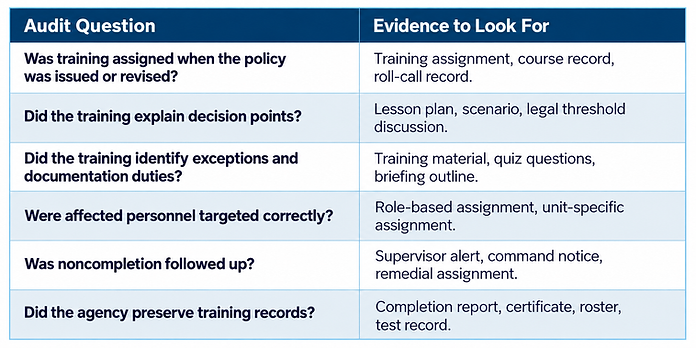


About the Author
Theodore L. Bremer Jr. is the Owner and Principal Consultant of Bremer Paralegal, LLC, where he works with law enforcement agencies on policy development, accreditation compliance, regulatory auditing, and agency reform. His experience spans public safety, including police, fire, EMS, courts, corrections, accreditation, and consulting. He previously served as a Police Supervisor, Accreditation Manager, and Training Officer during a 25-year law enforcement career. He later worked as a Senior Police Accreditation Analyst and Policy Writer, auditing more than 200 law enforcement agencies and maintaining accreditation-compliant policy language for 226 client agencies. He also served as a lead accreditation consultant to the NYPD Training Academy and the New Jersey State Police during their CALEA accreditation efforts. He is an experienced accreditation assessor. He holds a Master of Science in Criminal Justice from the University of Central Florida, a Graduate Certificate in Paralegal Studies, and is a member of Alpha Phi Sigma, the National Criminal Justice Honor Society.